

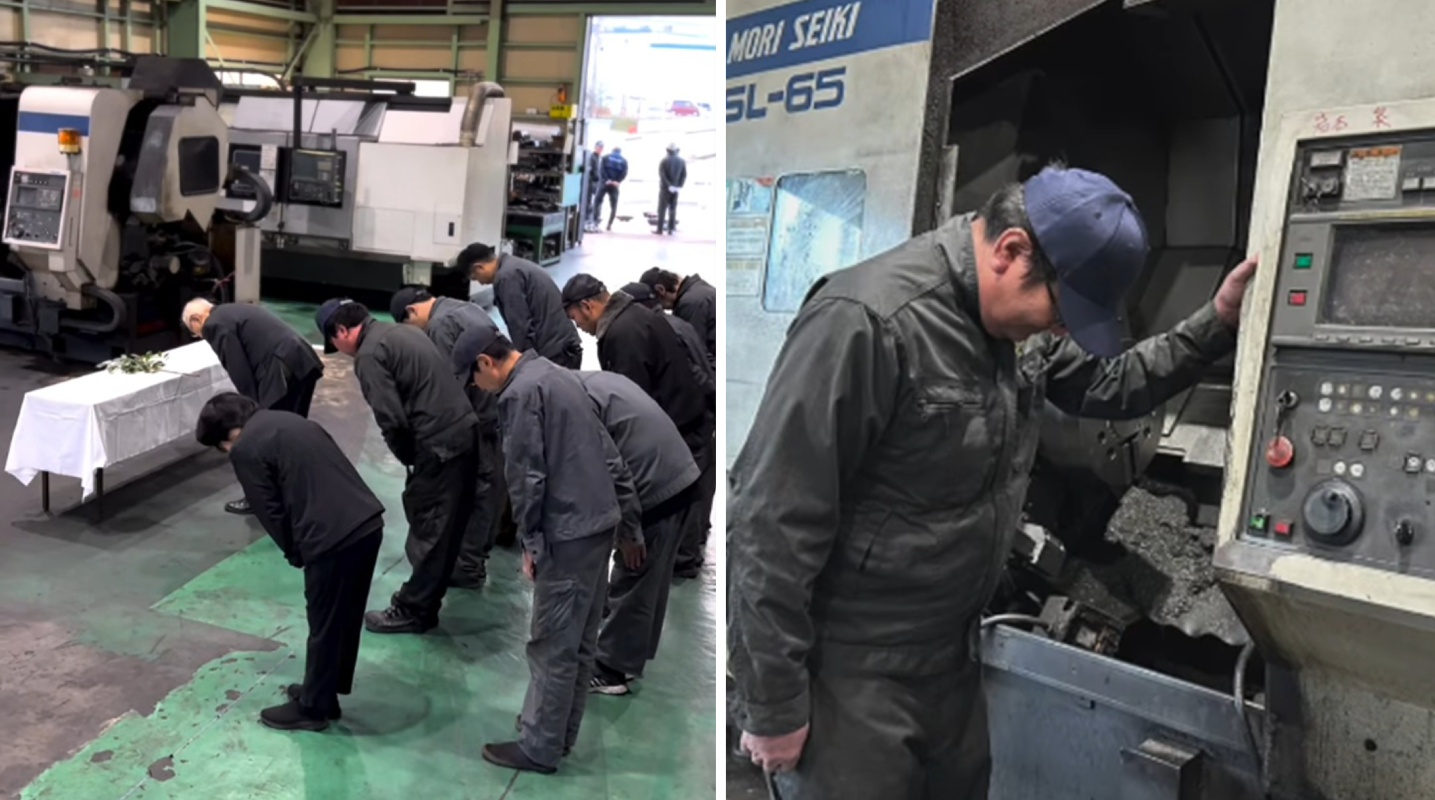
Most people wouldn’t think twice about replacing an old piece of machinery, but workers at a factory in Japan decided that two of their longest-serving machines deserved a proper send-off.
Thank you for reading this post, don't forget to subscribe!Rather than simply removing the ageing equipment and bringing in replacements, employees held a traditional ceremony to express their gratitude for decades of reliable service.
The unusual farewell took place at Matsuda Yasu Ironworks in Tottori, Japan, in August 2026, where two CNC machines were being retired after spending a combined 67 years in operation.
One machine had been working for 30 years, while the other had served the factory for an impressive 37 years.
For the people who had relied on them throughout their working lives, their departure was apparently worth marking.
The factory organised a traditional Japanese purification ceremony known as kiyoharai, allowing employees to formally acknowledge the machines’ contributions before they were removed from the workshop. They company later shared footage of the ceremony to its Instagram page, and can be seen below:
The ceremony was led by a 92-year-old former factory manager, who joined current staff in paying tribute to the equipment.
The translated caption read: “Nice to see new machines coming in but Missing the machine that served me for so many years.”
It also identified the two pieces of equipment as a 30-year-old NC machine and a machining centre that had been in operation for 37 years.
The message concluded with a simple acknowledgement of their contribution. “Thank you for your hard work over the years! Thank you,” they signed off.
Following the ceremony, both machines were carefully removed from the facility, making way for the next chapter of the workshop’s operations.
While holding a farewell ceremony for industrial equipment might seem unusual to people elsewhere in the world, the practice has connections to Japanese traditions surrounding respect and purification.
The concept of kami, often associated with the Shinto tradition, also featured prominently in discussions about the ceremony. Rather than being limited to people, spiritual significance can be associated with elements of the natural world, including trees and rocks.
However, ceremonies of this kind are not something that takes place at every Japanese workplace.
The factory’s decision nevertheless struck a chord with social media users, particularly those who understood the attachment that can develop between workers and the equipment they use every day.
One commenter offered a spiritual interpretation of the gesture, they wrote: “The Kami ‘spirit’ dwells in all and everyone. Trees, rocks, you and I. A sign of respect is not out of question. Not to mention its designer, creators and their life dedicated to make things work. All passed long ago probably but their work lived on and served many day in day out.”
Others appreciated the ceremony from a more practical perspective.
Another Instagram user, who had spent years working with industrial machinery, found the gesture particularly touching, saying: “As someone who has worked in machining his whole adult life, I find this incredibly sweet.”
Another commenter reflected on advice they had received growing up, typing: “My Dad always said take care of your things and they will take care of you.”
In a world that is always evolving, updating, and growing – especially when it comes to technology – it’s nice to see people pay their respects to what made it all possible.
Featured image credit: Instagram/@matsuda_yasu.ironworks
