

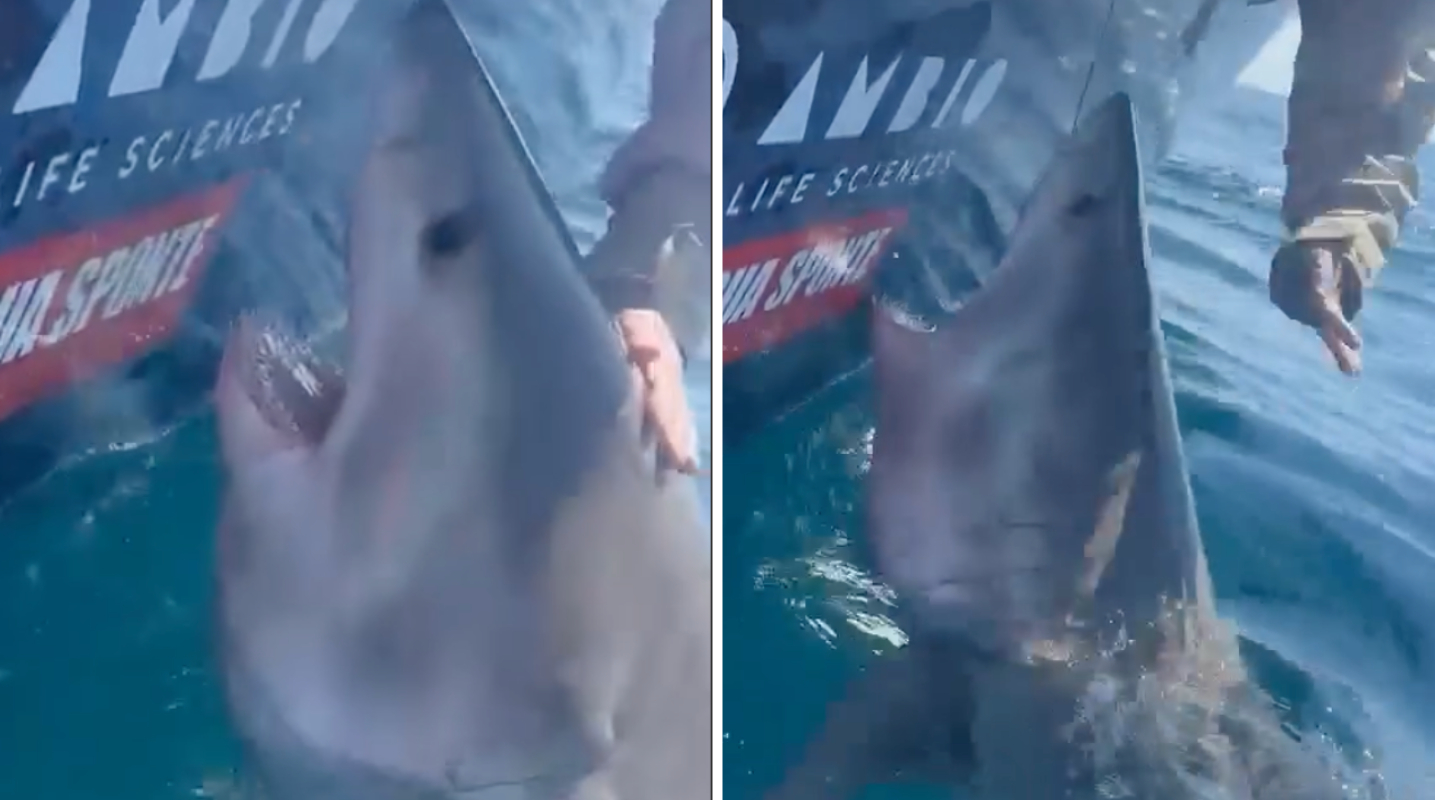
A woman attempting to stroke a great white shark from the side of a boat received a frightening reminder of just how unpredictable the ocean’s most powerful predators can be.
Thank you for reading this post, don't forget to subscribe!Footage filmed off the coast of Georgia, US, shows the enormous shark suddenly thrashing towards the vessel moments after the woman reaches down to touch its head.
The encounter took place during a fishing expedition organised by Knot Lucky Fishing, a Savannah-based non-profit that provides free fishing trips for military veterans, active service members and their families.
The woman, a veteran named Jen, was participating in one of the organisation’s shark research trips near Tybee Island when the incident unfolded.
In the video, Jen can be seen leaning over the edge of the boat and gently stroking the shark on the back of its head.
However, the animal quickly reacts, lunging forward and striking the side of the vessel with its mouth.
Fortunately, the shark makes contact with the boat rather than Jen’s hand, and nobody is injured. Watch the moment unfold below:
Knot Lucky Fishing subsequently shared the footage on Facebook, joking that Jen had attempted to pet the enormous predator as though it were a family dog.
Unfortunately for her, the shark “had other ideas”.
The organisation acknowledged how startling the encounter appeared, writing: “Everybody on the boat felt that one in their chest.”
The video quickly attracted attention online, with viewers questioning why anyone would attempt to touch a great white shark in the first place.
One Facebook user simply asked: “Why are we petting great white sharks?”
Another questioned whether the animal had actually been attempting to attack the woman.
“‘Lunged’. I think the shark was far more interested in getting off the hook than trying to take a bite out of the woman,” they wrote.
A third commented: “Why would you want to pet a shark?”
Meanwhile, another viewer suggested the animal was simply reacting to an unfamiliar situation.
“What does one expect from a shark trying to protect itself?!”
Despite the alarming footage, Knot Lucky Fishing insisted that Jen had not been in any immediate danger.
The organisation explained that its experienced crew had maintained control of the situation throughout the encounter.
“The crew had that shark under control the whole time, and it never got close enough to do any harm,” it said.
“But that reaction right there is a reminder of exactly what these animals are. Beautiful. Powerful. Wild. They deserve every ounce of respect we can give them.”
The organisation’s founder, Jimmy Armel, a former Army Ranger, also addressed the incident in comments to The Independent.
He explained that the footage had been captured during one of the group’s shark-tagging expeditions, which combine marine research with opportunities for military veterans to spend time on the water.
The programme operates alongside Starbrite, Project SeaSafe and Gray FishTag Research, with the aim of collecting information about great white shark movements and migration patterns.
During these expeditions, the team catches sharks, attaches tracking tags where it is safe to do so, and releases the animals back into the ocean.
The information gathered helps researchers better understand where the sharks travel and how they behave in the wild.
However, the programme also has a personal significance for those taking part.
Each shark successfully tagged by the organisation is named in honour of a fallen military service member, combining scientific research with a tribute to those who have lost their lives in service.
Explaining the purpose of the initiative, Knot Lucky Fishing wrote: “We catch, tag, and release great whites to collect real research on where they go and how they live, and every shark we tag carries the name of a fallen brother. Science and honor on the same deck.
“Huge thanks to Starbrite and Gray’s FishTag Research for standing with us and making this mission possible.”
Interestingly, the shark involved in Jen’s encounter was not ultimately tagged.
The organisation explained that the crew had been unable to find a safe opportunity to attach a tag and decided against attempting the procedure.
It emphasised that collecting research data would never take priority over the safety of the animal or those on board.
“The shark’s safety and the crew’s safety come first, every single time, so we let that shark go to swim another day.”
Nevertheless, it feels like this shouldn’t need to be said – but, apparently it does: DO NOT PET SHARKS LIKE THEY’RE DOGS.
Featured image credit: Facebook/ Knot Lucky Fishing (screenshots)
