

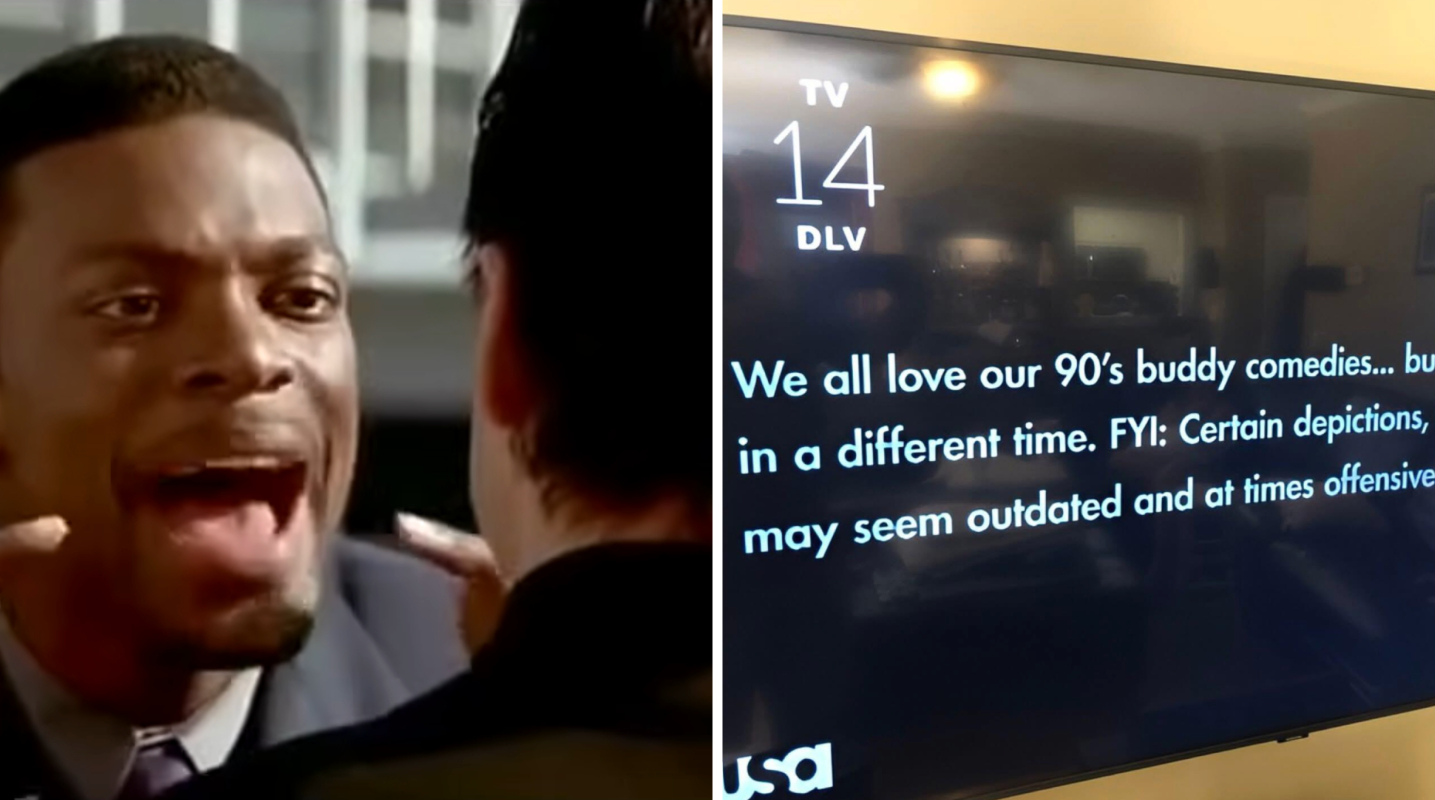
More than 25 years after Rush Hour first hit cinemas, the action-comedy is still getting people talking – although this time it isn’t one of Jackie Chan’s stunts or Chris Tucker’s one-liners causing the debate.
Thank you for reading this post, don't forget to subscribe!USA Network has reportedly added a disclaimer before airing the 1998 movie, warning viewers that elements of the film may now be considered outdated or offensive.
In several posts shared to Reddit, the message shown before the movie reads: “Certain depictions, language and humor may seem outdated and at times offensive.”
Rather than editing or removing scenes from the film, the warning appears to form part of a broader approach of providing additional context before older movies are broadcast.
But after the disclaimer was highlighted on social media, plenty of viewers made their feelings known.
Released in 1998, Rush Hour stars Jackie Chan and Chris Tucker as two very different law enforcement officers forced to work together.
Chan plays Hong Kong detective Inspector Lee, while Tucker stars as LAPD detective James Carter, with their unlikely partnership providing much of the film’s comedy.
The movie became particularly well known for combining Chan’s martial arts and stunt work with Tucker’s fast-talking performance, with the chemistry between the pair ultimately helping turn Rush Hour into a franchise.
Two sequels followed, with Rush Hour 2 arriving in 2001 and Rush Hour 3 in 2007.
However, the original movie was released in a very different era, and USA Network’s disclaimer acknowledges that some of its material may be received differently by viewers today.
The decision has generated a sizeable reaction online, with some people questioning why a warning was necessary at all.
One commenter wrote: “And the world keeps getting weaker and weaker”. The comment attracted more than 15,000 likes.
Another person took a different position, arguing that adding a message before the movie was preferable to changing the film itself, or not showing it altogether. They wrote: “I will take this over censorship any day!”
That distinction is an important part of the discussion surrounding the warning. According to the social media post highlighting it, the approach is about adding context to older films rather than editing or removing the original material.
Still, not everybody was impressed.
Another viewer simply commented: “Soft”
One person went even further, writing: “Take the warning away, let this soft generation learn to swim.”
Meanwhile, another said: “I’m really starting to hate my generation.”
Someone else described the disclaimer as: “A message for the soft generation.”
The response illustrates how quickly a short message before a decades-old film can turn into a wider conversation about changing attitudes towards entertainment – in particular, comedy.
What do you think? Are you supportive of disclaimers like this, or should people have the common sense to recognise that certain things are simply products of their time, and they should be viewed as such.
Featured image credit: Reddit/YouTube/Warner Bros. (screenshots)
