

After making his fortune in the tech industry, Marcel LeBrun could have chosen to spend his time and money almost anywhere.
Thank you for reading this post, don't forget to subscribe!Instead, he decided to build an entire community designed to give people experiencing homelessness somewhere to call home.
LeBrun was the CEO and co-founder of Radian6, which was sold to Salesforce in 2011. With a multi-million net worth behind him, he turned his attention towards homelessness and the housing crisis in North America.
But LeBrun is open about how much opportunity played a role in his own journey.
“I won the parent lottery, the education lottery, the country lottery,” LeBrun told Macleans. “It would be arrogant to say every piece of my ‘success’ was earned, when so much of it was received.”
Before launching his nonprofit, 12 Neighbours, LeBrun travelled across the United States, Canada and Ghana to examine how different organisations were tackling homelessness and poverty.
He eventually committed to funding 99 tiny homes in Fredericton, New Brunswick.
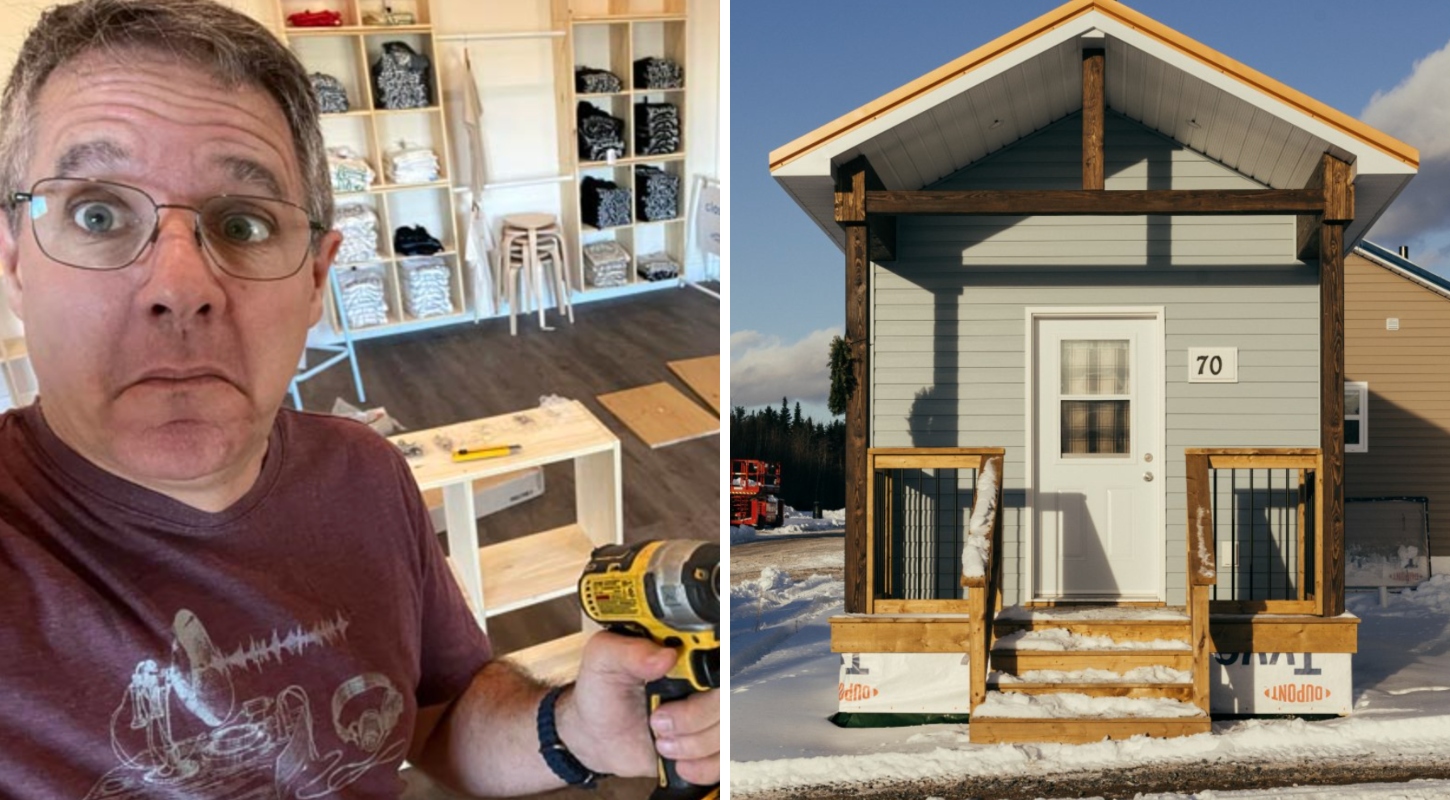
Several years later, the village has grown to more than 100 homes, each measuring 240 square feet.
Every compact property includes a living space that doubles as a bedroom, alongside a fully-equipped kitchen and three-piece bathroom. Solar panels sit on the roofs, while front porches provide residents with space to gather.
The neighbourhood also has a social enterprise centre featuring a cafe, retail shops, workshops and community gardens.
For LeBrun, simply providing housing isn’t the end goal.
“A lot of our systems provide support when someone showcases their deficits. Then, as they progress towards success, the supports fall away,” he said.
“In business as you succeed, investments increase. How can we structure things so people can unlock benefits as they succeed as opposed to having to showcase their deficits?”
Residents pay rent equivalent to 30% of their income, meaning most pay no more than $200 per month, with utilities and internet included.
For resident Marla Bruce, the impact has been enormous.
“Marcel is literally a Godsend,” she said.
“A year ago, I was homeless. Now I have a home, I’m not on the street and I have peace because every place where I stayed before was temporary. Here there is very much a sense of community. Marcel has a heart and a passion for what he is doing.”
Residents range from 18 to 70 years old and have access to substance use counselling and personal development groups, including support with obtaining GEDs and finding employment.
Some residents also work at a nearby pop-up coffee shop or in a printshop producing merchandise for the nonprofit.
LeBrun, however, doesn’t see himself as somebody arriving to rescue people.
“Building community and being in community is inherently rewarding,” he said.
“Getting to know so many amazing and resilient people, who have carried and overcome so much, who have incredible strengths, is rewarding. I don’t rescue or transform anybody. But we can create a community where transformation happens.”
And despite investing significant amounts of his own money into 12 Neighbours, LeBrun believes the bigger commitment is personal.
“The word ‘philanthropy’ is often interpreted as someone who gives money,” he said.
“But the Greek roots of the word ‘philos’ and ‘anthropos’ mean to love humans. What I have discovered is spending money is the easy thing, spending yourself is the hard thing. The 12 Neighbours project is how I can best spend myself.”
Featured image credit: 12 Neighbours / Instagram
