

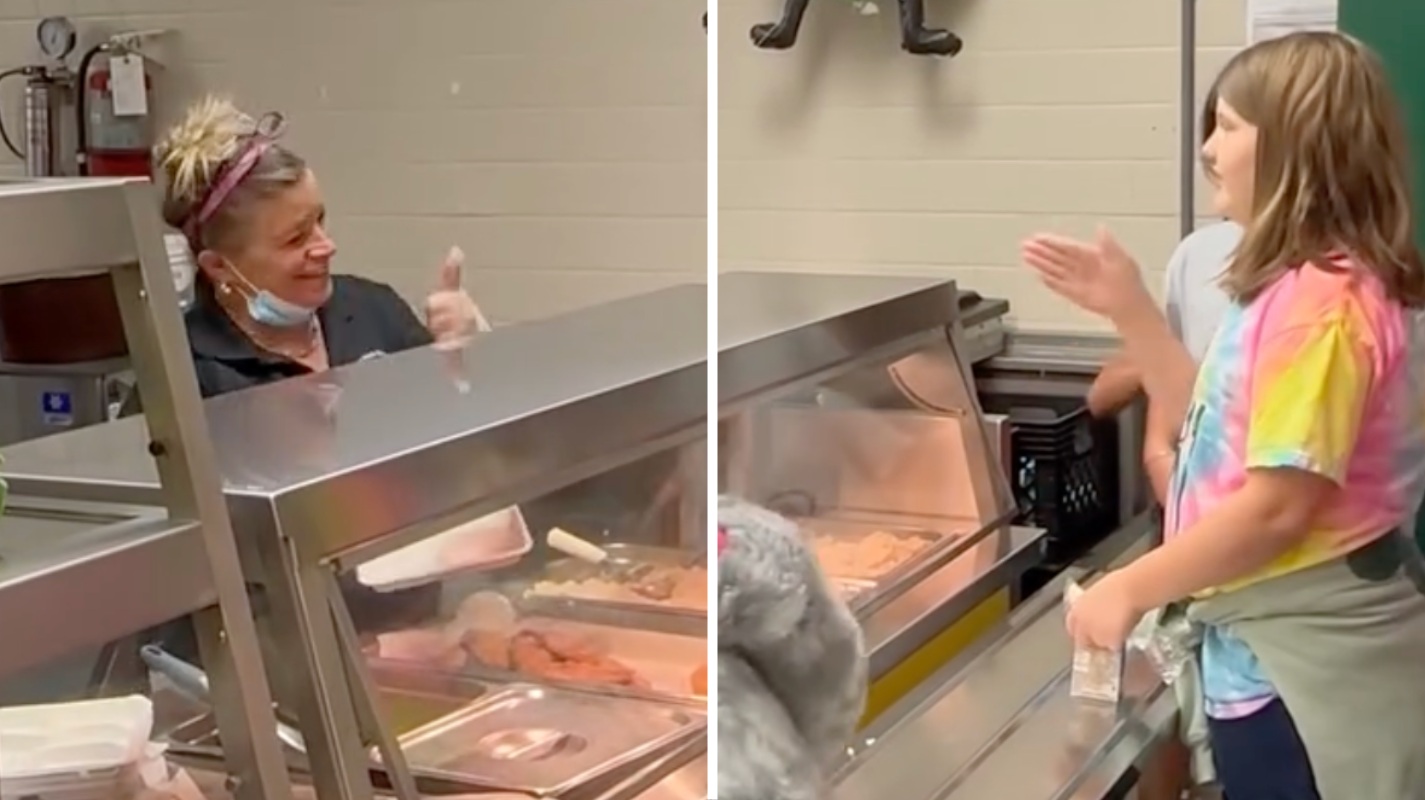
A heartwarming video has amassed praise after a group of elementary school students decided to learn sign language to communicate with their doting cafeteria worker.
Thank you for reading this post, don't forget to subscribe!The pupils at Nansemond Parkway Elementary School in Suffolk, Virginia, regularly saw cafeteria worker Leisa Duckwall when they collected their breakfast and lunch.
Duckwall is deaf and had worked at the school for four years, serving both students and staff, Upworthy reports.
While she and the children had previously done their best to communicate with each other, things changed when fourth-grade teacher Kari Maskelony had a conversation with Duckwall in front of the students.
Rather than speaking, the pair communicated using American Sign Language (ASL). And their interaction immediately caught the children’s attention.
The cafeteria apparently fell silent as students watched the two women communicate using their hands.
Maskelony already knew sign language because she had grown up in a family that was hard of hearing, meaning it had been part of her own life. And after noticing how fascinated the children were by the exchange, the teacher had an idea.
She asked whether they would like to learn sign language themselves.
The answer eventually resulted in far more than just a few students picking up a handful of signs.
What started from one interaction in the cafeteria grew into a schoolwide effort to give the children a new way of communicating with Duckwall.
The school’s principal learned what was happening and decided to expand the idea. Morning announcements were used to help teach the students, with videos introducing them to a new word in sign language each week.
It meant the children could gradually develop a skill they could put into practice immediately with someone they already knew.
And for Duckwall, the project was about more than simply making conversations in the lunch line easier, as she explained that learning sign language could give the students a skill they could continue using long after leaving their elementary school.
“Not only is it great for the kids because they can learn a new skill that they can carry with them and actually use with other people that they meet,” she told The Virginian Pilot, “but I think it [is] great because equal inclusivity and equal access is so important. It’s just something that we don’t often see.”
A video of the children communicating with Duckwall quickly went viral across social media, with one person writing: “It must be SO hard to deal with a world where there is no sound at all and you have to rely on vision much more. These children and their teacher are amazing. This deaf woman must have been so touched by this and the world must have sounded very loud with love for her that day.”
A second added: “This is an awesome lesson on the importance of community and they are learning a great skill to be able to communicate with others as they get older!”
“The compassion, the care, the kindness, the selflessness,” a third commented. “These children are going places!”
The significance of making sign language more accessible extends well beyond the school.
One in eight people aged 12 and older in the United States have hearing loss in both ears, while more than 70 million people around the world use sign language to communicate.
Despite that, sign language is not widely known among people outside of the deaf community.
That can create an additional barrier for deaf people going about everyday life, particularly when the people and businesses around them cannot communicate using sign language.
Some major businesses and organisations, including Starbucks and Disney, have made efforts to incorporate ASL, but its use across businesses remains far from widespread.
Featured image credit: Facebook/Nansemond Parkway Elementary School
