

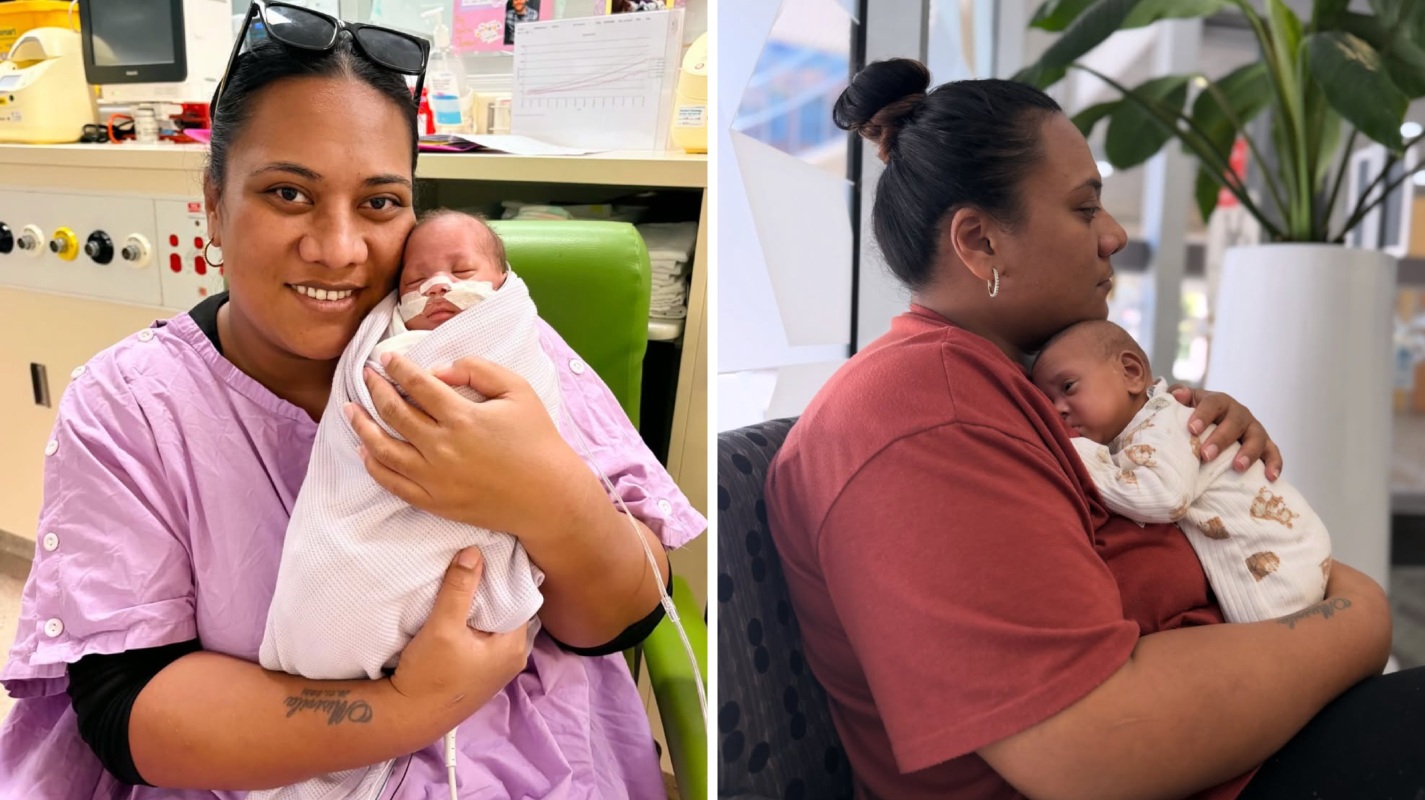
A baby girl whose survival stunned doctors has lived up to the name her family gave her before they could have known just how extraordinary her story would become.
Thank you for reading this post, don't forget to subscribe!Makerita Miracle Tanuvasa was born at just 21 weeks and three days, making her the most premature baby believed to have survived in Australia, PEOPLE reports.
Her arrival came after an extraordinary sequence of events for her parents, Annrose and Misi Tanuvasa, who went from discovering they were expecting a baby to being told their daughter could arrive almost immediately.
Annrose, from Queensland, visited her GP on March 20 after becoming suspicious that she may be in the early stages of pregnancy. She had recently completed a six-week gym challenge but had lost little weight, while an unusual sensation in her stomach also made her wonder whether she could be expecting.
At the time, she believed she might only be around four or five weeks pregnant.
An ultrasound delivered a completely different answer.
“I went to do an ultrasound and the sonographer told us that we were about 22 weeks pregnant,” she recalled to The Brisbane Times. “I said ‘that’s impossible’.”
Annrose had suffered a miscarriage in December, something that initially appeared to offer a possible explanation for what doctors were seeing: “[The sonographer] said, ‘Well, maybe you had a twin, and you miscarried the twin … you’ve got to go to the hospital and you’ll be staying there until you give birth’.”
Annrose later explained that during the same visit in which she discovered she was pregnant, she was told that her baby “could be delivered any day”.
By that afternoon, she had been admitted to hospital.
The situation was extremely serious.
Annrose said she was told that no hospital in Queensland would resuscitate a baby before 23 weeks because of the dangers associated with birth at such an early stage.
“The risk for long term disability is too high, and to resuscitate a baby that small and fragile is almost like torturing the baby,” she wrote on Instagram.
Five days after discovering how far along she was, Annrose gave birth at the Royal Brisbane and Women’s Hospital at 7:08PM.
Makerita Miracle Tanuvasa weighed only 351 grams.
That made her the smallest newborn in Queensland history.
Her weight was 23 grams less than that of Jonathon Heeley, who was born in 1992 and became known as Australia’s “Coke Can Kid” because of comparisons between his size and a soft drink can.
But doctors would later discover something even more remarkable about Makerita’s birth.
Initial scans had suggested Annrose was approximately 22 weeks pregnant and that the baby was measuring around 500 grams.
Miracle’s size after delivery, however, did not appear to fit those estimates.
“A week later the doctor came in to see me, and she said, ‘She’s just not matching the scans that you came in with, she doesn’t match that baby’,” Annrose explains. “I was measuring at 500 grams, measuring at 22 weeks pregnant.”
Annrose was then asked to retrieve scans taken before her miscarriage in December.
After examining them, doctors concluded that the pregnancy had begun earlier than initially thought.
“They said, this has got to be the same pregnancy,” she recalled.
Makerita was ultimately determined to have been born at 21 weeks and three days.
That placed her even earlier than Stevie O’Reilly, who had previously been considered Australia’s most premature surviving baby after being born at 22 weeks and two days at Townsville University Hospital.
It also put Makerita close to the recognised world record, which is recognised by Guinness World Records as Nash Keen, born in Iowa in July 2024 at exactly 21 weeks – who went on to become the world’s most premature baby to survive.
For Annrose and Misi, however, records were far from their minds when they first saw their daughter. “I took one look at her and I was like, ‘there’s no way she’s going to make it’,” remembers Annrose.
Makerita was approximately the size of her father’s palm. “We weren’t able to hold her, but she was very, very small,” Misi says.
Her condition left even experienced medical staff struggling to explain what they were witnessing.
“Even the doctors couldn’t explain how she was able to survive everything she’s gone through,” says Misi.
Annrose said one doctor was equally unable to provide a clear explanation for her daughter’s progress.
“She said, we can’t give you any answers. Everything is actually just a miracle. And I just said, ‘well, let’s keep it like that’.”
The first weeks of Makerita’s life were filled with uncertainty.
She remained inside a neonatal intensive care incubator, surrounded by tubes and cables as a multidisciplinary medical team monitored her.
For roughly a month, her parents could only speak to her from behind the glass.
Four weeks after her birth, they were finally allowed to hold her.
“It was magical, but it was also very scary, holding such a tiny baby,” says Annrose.
Makerita remained in the Royal Brisbane and Women’s Hospital intensive care unit for 14 weeks.
Six weeks into that period, Annrose moved into Ronald McDonald House in Herston as she and Misi balanced caring for Makerita with parenting their two other children, aged one and four.
The uncertainty surrounding their daughter’s condition remained constant during the early stages.
“Every visit, it was like real quiet, like almost like no one wanted to tell us, ‘we don’t know if she’s going to survive or not’,” Annrose recalls. “But I think after one month, it just started to get real bright in the room.”
As the weeks passed, Makerita continued to make progress. “It was just like she was here to fight,” says mum Annrose.
She was eventually moved from the Royal Brisbane and Women’s Hospital to the special care nursery at Logan Hospital. And by early August, more than four months after being born, Makerita was finally ready to go home.
Her discharge came at around the point she would have reached 40 weeks’ gestation had the pregnancy continued to full term.
For the medical staff who cared for her, her survival was unlike anything many had previously encountered.
“I haven’t seen a 21-plus-three-weeker,” says registered nurse Renee Judd. “We’ve had other little babies here, but not that young, and I have been 16 years in the neonatal journey in Logan.”
The hospital marked Makerita departure with an emotional send-off.
Nurses and midwives formed a guard of honour as Annrose carried her daughter out of the facility.
Annrose and Misi became emotional as they thanked the huge number of people involved in caring for their daughter throughout her hospital stay, saying: “Thank you, guys, so much for all the love and care you gave our daughter, the nurses, the doctors, the cleaners … social workers, Ronald McDonald House in Herston. Thank you, guys, so much for everything.”
The name Miracle had significance to the family even before the full scale of her story became clear. Her middle name had been selected by Annrose’s mother “before and after” anyone knew the baby existed.
Her first name, Makerita, was chosen in honour of one of Annrose’s late aunts, who had been particularly close to Annrose’s mother.
As Makerita Miracle continued to survive circumstances that had initially appeared overwhelming, that name took on a remarkable new meaning.
“And indeed, what a Miracle she is,” Annrose wrote.
Featured image credit: Instagram/@annrose_tanuvasa
