

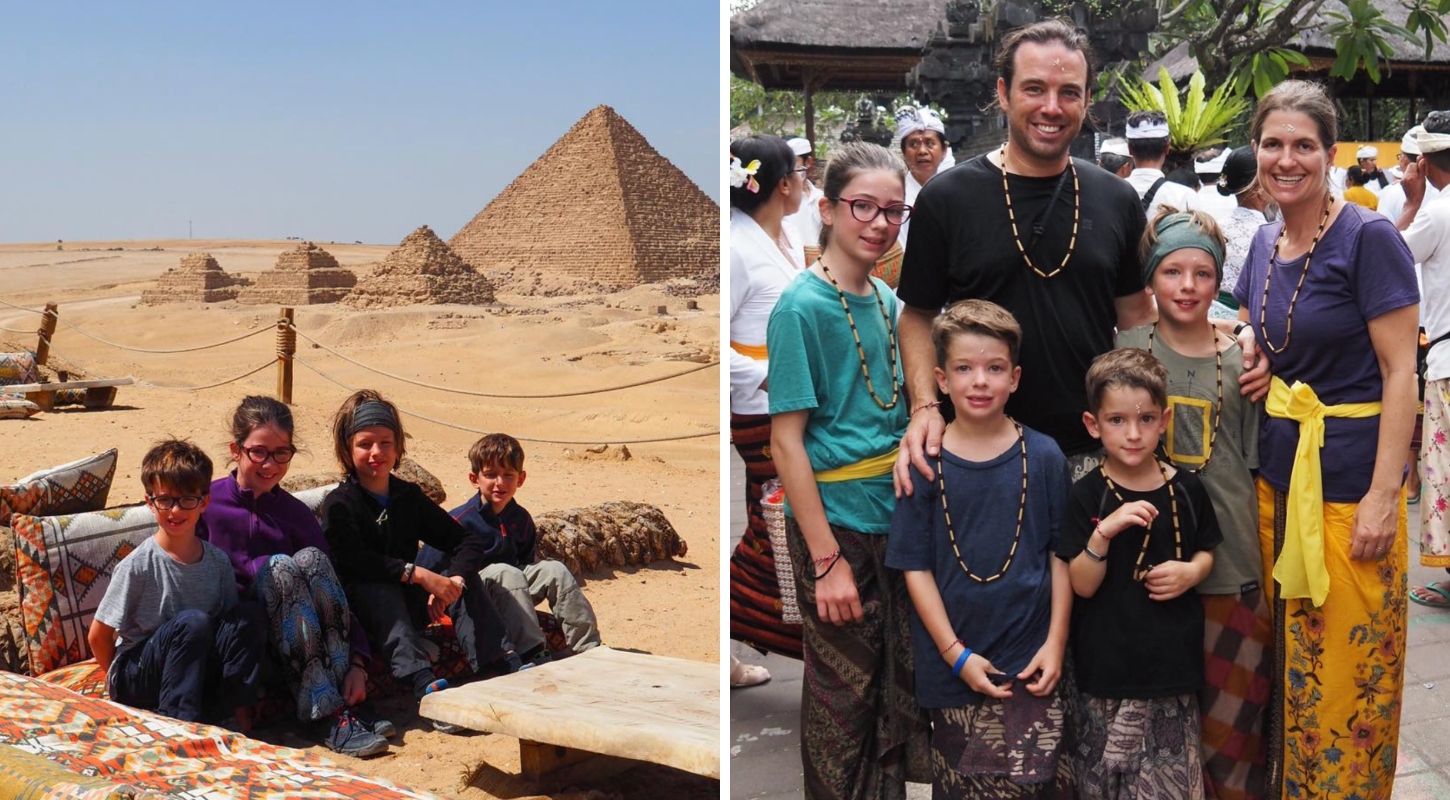
A Canadian family embarked on an extraordinary journey around the world after learning that three of their four children could eventually lose their sight.
Thank you for reading this post, don't forget to subscribe!Edith Lemay and Sebastien Pelletier first realised something was wrong when their eldest daughter Mia began experiencing vision problems at just three years old, per CNN.
Several years later, Mia was diagnosed with retinitis pigmentosa, a rare genetic condition that causes vision to deteriorate over time.
The couple then noticed similar symptoms in two of their sons, Colin and Laurent. In 2019, both boys were diagnosed with the same condition, while their other son Leo was given the all clear.
“There’s nothing you can really do,” Lemay said.
“We don’t know how fast it’s going to go, but we expect them to be completely blind by mid-life.”
Faced with an uncertain future, the parents began preparing their children for the challenges that could lie ahead.
But one suggestion from Mia’s specialist changed their approach entirely: give their daughter as many “visual memories” as possible while she could still experience them.
“I thought, ‘I’m not going to show her an elephant in a book, I’m going to take her to see a real elephant,” Lemay explained. “And I’m going to fill her visual memory with the best, most beautiful images I can.”
That idea eventually became a plan to travel the world as a family.
The six were initially supposed to leave in July 2020, but pandemic travel restrictions forced them to postpone and repeatedly rethink their plans.
Eventually, they left Montreal in March 2022 without a fixed route.
“We actually left without an itinerary,” Lemay said. “We had ideas of where we wanted to go, but we plan as we go. Maybe a month ahead.”
Their adventure began in Namibia, where the children encountered elephants, zebras and giraffes. They continued through Zambia and Tanzania before visiting Turkey, Mongolia and Indonesia.
“We’re focusing on sights,” Pelletier explained. “We’re also focusing a lot on fauna and flora. We’ve seen incredible animals in Africa, but also in Turkey and elsewhere.
“So we’re really trying to make them see things that they wouldn’t have seen at home and have the most incredible experiences.”
The journey is about more than creating a bank of incredible images.
Lemay and Pelletier also want their children to develop resilience and learn to adapt, particularly as Mia, Colin and Laurent may need to continually adjust to deteriorating eyesight.
For the youngest children, understanding exactly what that could mean has brought difficult moments.
“My little one asked me, ‘Mommy, what does it mean to be blind? Am I going to drive a car?’” Lemay said. “He’s five. But slowly, he’s understanding what’s happening. It was a normal conversation for him. But for me, it was heart-wrenching.”
Despite the uncertainty, their parents remain focused on giving all four children experiences they can carry through life.
Pelletier also remains hopeful that scientific advances could change their future.
“Hopefully, science will find a solution,” he said. “We cross our fingers for that. But we know that it might happen, so we want to make sure our kids are equipped to face these challenges.”
Featured image credit: pleinleursyeux / Instagram
