

It’s heartbreaking to think that any child should have to experience the fear and uncertainty of being in hospital, let alone face the prospect of being taken away from their parents and into an operating room.
Thank you for reading this post, don't forget to subscribe!But one doctor has found a simple way to make that journey feel less like a frightening medical procedure and more like the beginning of a superhero mission.
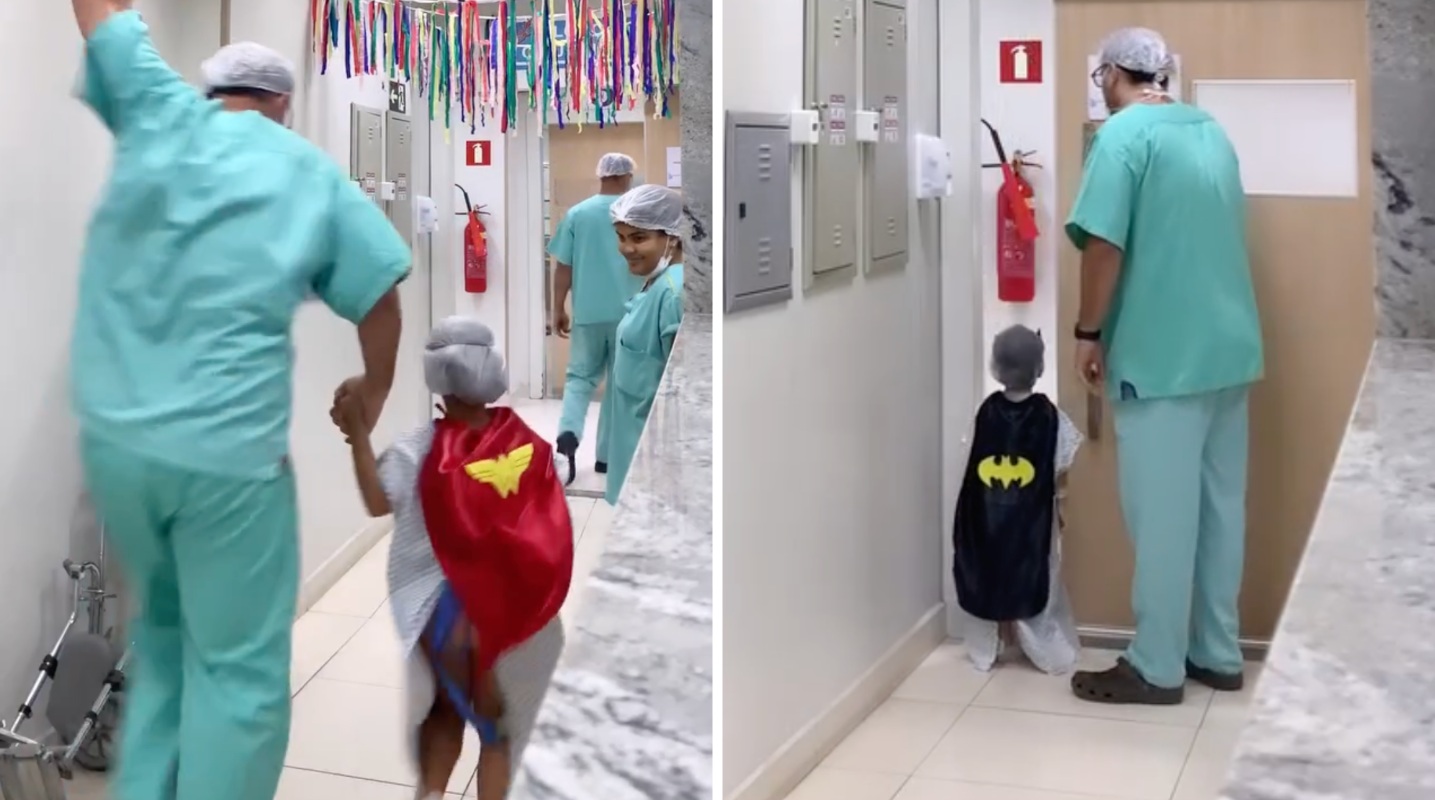
Dr. Leandro B. Guimarães, an otolaryngologist in Brazil, dresses his young patients in superhero costumes before surgery, helping transform an understandably stressful moment into one filled with play, excitement and courage.
Instead of approaching the operating room frightened and in tears, children can make the journey dressed as characters including Batman and The Flash.
Some run towards surgery holding Guimarães’ hand. Others get to “fly”, balanced over the doctor’s shoulder as they make their way through the hospital.
And the touching reason behind the tradition can be traced back to one little girl.
Guimarães explained that operating rooms can naturally be tense places, particularly for children who may struggle to understand what is about to happen.
“This idea came from my desire to make the surgical room entrance less stressful,” he told TODAY. “The last child I took into surgery … was Allana, a little girl about two years old who entered in my arms, crying uncontrollably. That day, I promised myself that I would never take a child into surgery crying again.”
Rather than accepting that fear as an unavoidable part of the process, Guimarães decided to find another approach.
Superheroes became part of the answer.
He orders different costumes and allows each child to decide who they would like to become before their operation.
“I let the child choose which one they want to wear,” he told TODAY, adding: “I explain to them that we will go in ‘flying’ or running and that we are going to clear their nose and ears! I enter the surgical room when they are ready and engaged in the game. If I notice they are still scared, I ask a parent to come in with them. That way, anesthesia induction is always calmer.”
The costumes may be the most immediately noticeable part of what Guimarães does, but the thinking behind them goes much deeper.
For him, engaging with children emotionally and through play can be an important part of their experience of medical care.
“My daily work is a joy,” Dr Guimarães continued. He adds: “By using playfulness, we can engage with children in a very effective way.”
That approach didn’t begin when he became a qualified doctor.
Guimarães’ ability to use performance and play with young patients can be traced back to his time at medical school, when he joined a clown group. It gave him experience using theatre and comedy to interact with children in hospital environments, skills which would eventually become part of the way he practised medicine.
“When I started medical school, I joined a clown group where we had theater classes to learn how to be clowns and how to distract children during our weekly visits to pediatric inpatients at the university hospital,” says Guimarães. “Since then, I fell in love with working with children, and over time, the skills I learned as a hospital clown also helped me examine children in the office without scaring them.”
Years later, that philosophy can now be seen in the superhero process he has created for children preparing for surgery.
Once the child has chosen a costume, the objective is to get them engaged with the game before they enter the operating room.
The transformation can have an effect on more than the patient.
Parents who would ordinarily be watching their child enter surgery during an intensely emotional moment instead get to see them running or “flying” towards the operating room dressed as a superhero.
“Most children love them,” he says. “They get super excited and feel empowered when they put on the costume! They walk in so happily that their parents also feel at ease and almost forget that they are entrusting me with their most precious treasure for surgery.”
But the capes don’t replace the child’s need for reassurance. If Guimarães believes a patient remains frightened despite the costume and playful entrance, he asks a parent to accompany them.
After the child falls asleep for the procedure, their superhero outfit is removed and handed to their parent.
Guimarães also records the entrances and sends the footage to families, creating a reminder of how their child approached what could otherwise have been an intimidating experience.
“I usually record the child’s entrance and send the video to the mother — they love it because they can show their children how brave they were,” he says.
And the costume doesn’t stay at the hospital – every child gets to take theirs home following surgery!
The tradition has apparently become so popular that children being treated by other doctors notice the outfits too.
Videos of the tradition have also reached a far bigger audience online.
One Instagram video shows his costume-wearing patients making their dramatic journeys towards surgery, either running with the doctor or being carried as though they are flying.
The clip was accompanied by Ben E. King’s ‘Stand By Me’, and viewers quickly flooded Guimarães with praise and support.
“You’re an angel,” one person commented, with another writing: “The way energy can change a moment.”
Another gushed: “I can see your cape too.”
The initiative has subsequently gained international recognition.
In 2025, Guimarães received a WEmbrace Award in the Inspiring Stories category, an international honour recognising professionals and projects associated with inclusion, innovation, and social impact within healthcare.
But some of the reactions that appear to mean the most to Guimarães don’t come from awards or social media. They come from the children themselves.
You see, for most people, hearing that a child wants to return to hospital for another operation would sound almost unfathomable. Yet Guimarães says some of his former patients have been left with such positive memories of the experience that they have said exactly that.
“I get emotional when parents tell me that their children pass by the hospital and say they want to have surgery again because their memory of the experience is positive, full of play and fun,” he says.
Somebody get this man his own cape!
Featured image credit: Instagram/otorrino.leandro (screenshots)
