

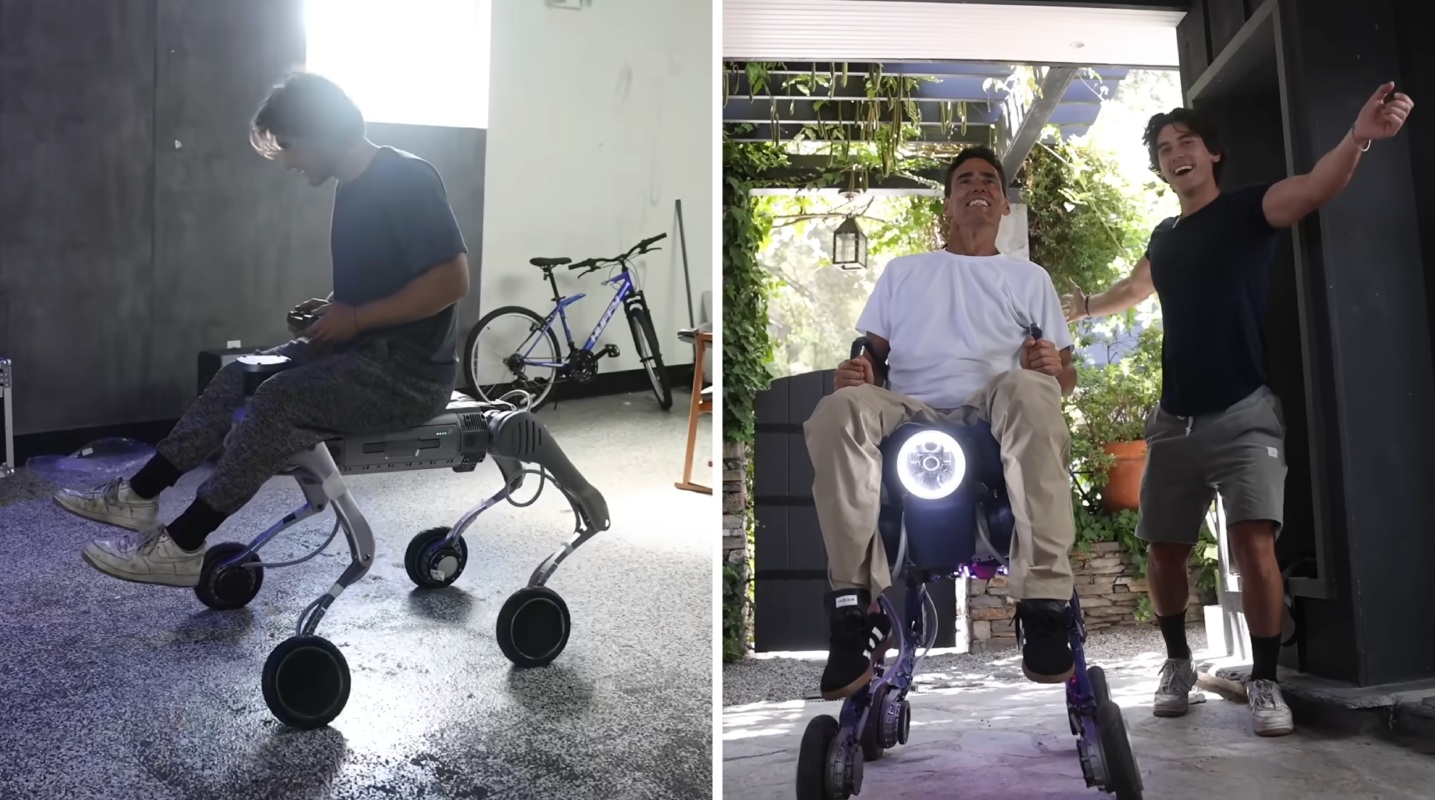
An engineer has transformed an industrial robotic dog into a remarkable four-legged mobility chair for his father, allowing him to tackle terrain that would be virtually impossible in a conventional wheelchair.
Thank you for reading this post, don't forget to subscribe!Jake Laser, the engineer and YouTuber behind JLaservideo, created the machine for his dad, who has lived with multiple sclerosis for 20 years.
The idea was born from a problem familiar to many wheelchair users.
Flat, accessible surfaces are one thing. Stairs, rocky trails, steep inclines and even a high curb can be tough obstacles to overcome.
But rather than attempting to make a traditional wheelchair more capable, Laser approached the challenge from another direction entirely.
He started with an industrial-grade quadruped robot made by Unitree and effectively turned it into a set of robotic legs his father could ride. Laser calls his creation the “bionic leg chair”.
And unlike a conventional four-wheeled mobility system, it isn’t limited to rolling along the ground.
The Unitree machine uses a hybrid design combining articulated robotic legs with powered wheels positioned beneath its feet. On suitable surfaces, it can simply roll around, but when the terrain becomes more demanding, those mechanical legs can step over obstacles and navigate uneven ground.
The robot used for the project is the Unitree B2-W, an enterprise machine that sells for around $100,000 and is designed for industrial applications such as inspections in warehouses or dangerous environments.
But turning such an advanced robot into something Laser’s father could actually sit on involved considerably more work than simply attaching a chair.
Laser experimented with multiple seating arrangements before settling on a racing bucket seat mounted directly above the robot’s spine. That positioning was crucial. The rider’s legs needed to extend forwards so that the mechanical limbs underneath could continue moving without interference.
Laser then added a heavy-duty safety harness, giving his father a secure seating position while the machine moved across unpredictable terrain.
There was another major challenge beneath the surface: balance.
Although the industrial robot is designed to transport substantial loads, carrying an actual person creates a very different engineering problem. A fixed load stays where it is placed. A human passenger naturally moves around, leans and continually alters the machine’s centre of gravity.
Laser therefore modified and recalibrated the robot’s software so its stabilisation systems could account for his father’s weight and movements.
With those changes in place, the onboard sensors, gyroscopes and motors could continually work to keep the chair balanced as it travelled.
Control of the finished machine is handled through a wireless dual-joystick transmitter. That gives the rider the ability to move forwards, turn, rotate and even strafe sideways.
Laser also made it possible to raise and lower the robot, an important feature when it comes to getting into and out of the seat.
Functionality, however, was only part of the project.
Laser wanted the machine to look like something his father could be proud to use, rather than an industrial robot with a chair sitting on top.
For its visual transformation, he took inspiration from classic Bugatti cars of the 1940s. Curved body panels were added alongside carbon fibre accents, vintage-style chrome headlights, LED underglow and custom spinner wheel covers.
The result is an unusual meeting point between an industrial quadruped robot, a futuristic mobility machine and a vintage-inspired vehicle.
Before his father was allowed anywhere near the controls, however, Laser wanted to know exactly what his creation could handle. He subjected it to an extensive series of tests, with the machine climbing large ledges, negotiating staircases, and making its way across rocky terrain.
In one particularly striking demonstration of its balance and precision, the robot was even made to walk across the open rungs of a ladder.
It also crossed a rocky riverbed without losing its footing.
Only after putting the modified machine through those trials did Laser allow his father to climb aboard.
That was when the engineering project became something far more personal.
After years of relying on a conventional wheelchair, his father could once again access trails and locations that had effectively been closed off to him.
The response online reflected just how strongly the project resonated with people.
One person commented: “This is just so beautiful”
Antoher social media user revealed his own personal connection to the story, writing: “Very cool dude! My mum has MS too and would definitely benefit from something like this !”
Another viewer summed up the wider potential people saw in the build: “This is what technology should be. What an amazing gift to give your dad. I know he’s proud of you. We all are”
For now, though, the machine remains a one-off creation rather than something wheelchair users can simply go out and buy.
Its starting point alone makes that reality clear: this technology can be used for greater purposes.
Featured image credit: YouTube/JLaservideo (screenshot)
