

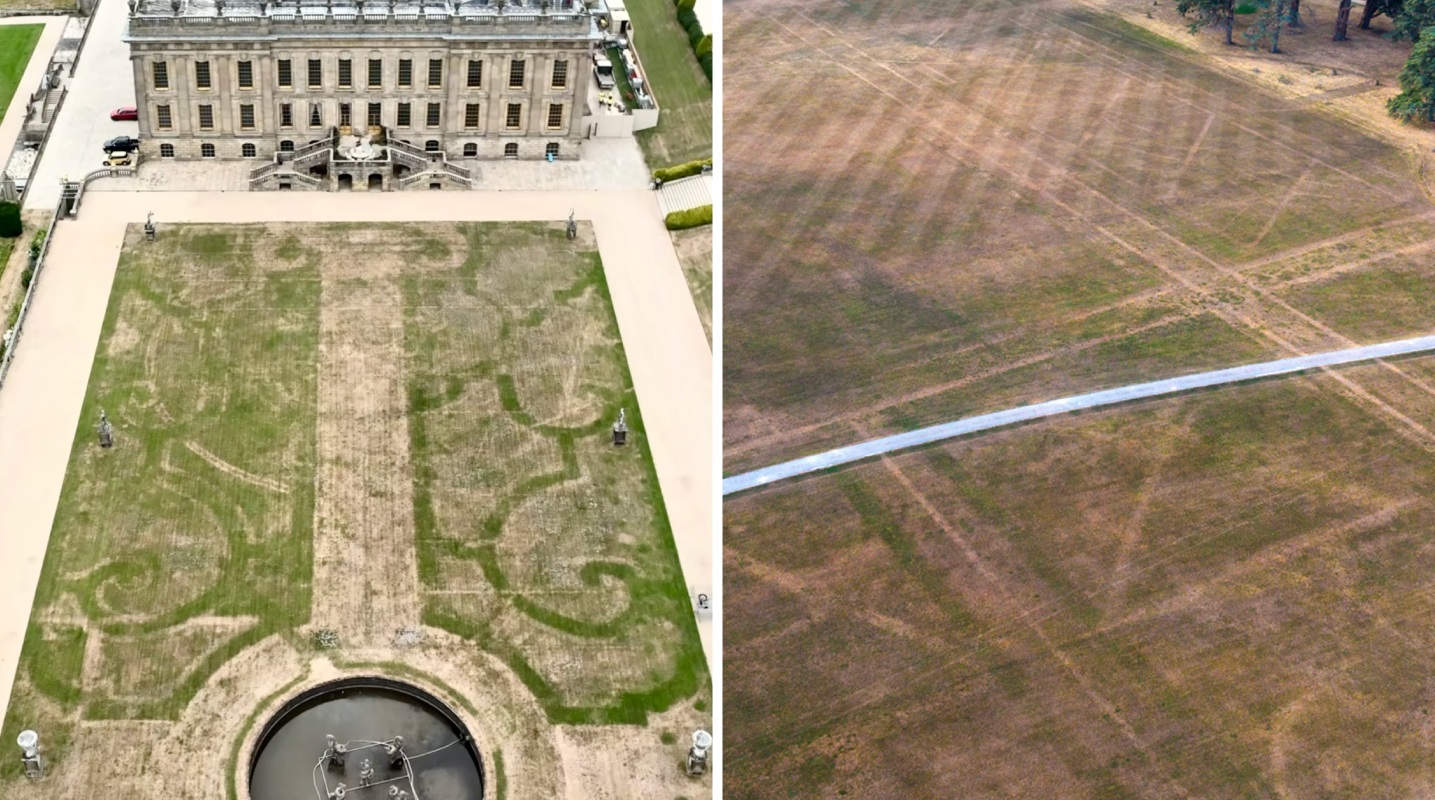
Britain’s prolonged hot and dry weather has produced an extraordinary side effect, with the outlines of gardens that disappeared hundreds of years ago becoming visible through scorched lawns.
Thank you for reading this post, don't forget to subscribe!Yes, while many of us have been suffering in weeks of unbearable temperatures, some timeless beauty has started to once again surface thanks to the heat.
Historic designs have emerged at both Blenheim Palace in Oxfordshire and Chatsworth House in Derbyshire, revealing patterns from formal gardens that were later removed during major landscaping work.
At Blenheim Palace, the dry conditions have exposed traces of a huge parterre garden dating back more than 300 years.
The original garden was created in 1705 by royal gardener Henry Wise and stretched across the full width of the palace.
It was surrounded by a high stone wall before being dismantled when renowned landscape gardener Lancelot ‘Capability’ Brown transformed the grounds in the 1760s.
Although the garden disappeared from the surface, traces of its layout remained beneath the lawn.
Blenheim Palace explained on its Instagram page: “Parterres are showing up everywhere! We’re calling this the Great British Parterre Off.
“With the prolonged hot, dry weather we’ve also spied a glimpse into our hidden parterre design at Blenheim Palace. And yes, we’ve pulled out our plans too @Chatsworthofficial.”
The palace added: “The original parterre was created in 1705 by royal gardener Henry Wise, stretched across the full width of the palace and was surrounded by a high stone wall. The garden was dismantled by renowned landscape gardener Lancelot ‘Capability’ Brown when he transformed the gardens in the 1760s.
“Fun fact: parterre is taken from the French word meaning ‘on the ground’ and refers to an ornamental, formal garden arranged around flower beds, paths and symmetrical patterns. We can imagine it was a sight of true opulence and beauty.”
Similar markings have appeared at Chatsworth House.
The patterns visible beneath its South Lawn belong to ‘The Great Parterre’, an ornate 17th-century garden created for the 1st Duke of Devonshire around 1699 to complement the newly completed South Front of the house.
Its elaborate flower beds and pathways disappeared beneath a new landscape in the 1730s.
The exceptionally dry conditions have now made parts of that old design visible again.
Chatsworth explained: “What first appears to be scorched grass is actually a glimpse into Chatsworth’s past. Recent high temperatures and prolonged dry weather have revealed the outline of ‘The Great Parterre’ beneath the South Lawn, an ornate 17th-century garden created for the 1st Duke of Devonshire around 1699 to complement the newly completed South Front of the house. The intricate flower beds and pathways disappeared beneath a new landscape in the 1730s, but in hot, dry conditions the contrast between the shallower-rooted turf and the original garden layout causes its spectacular swirling patterns to re-emerge.”
The estate said particularly sunny and dry conditions in 2026 helped reveal the historic layout.
Writing to its followers, officials for the estate explained: “Between March and May 2026, Chatsworth experienced 530 hours of sunshine, around 33% more sunshine than the regional average, while receiving 32% less rainfall than normal.
“Temperatures have exceeded 30°C in May, June and July, and the exceptionally dry start to July has left the South Lawn parched enough for history to reveal itself once again.”
The phenomenon occurs because features beneath the ground can affect how much moisture the soil above them retains.
During exceptionally dry conditions, different sections of grass can therefore die or change colour at different rates, allowing outlines that would otherwise be invisible to appear on the surface.
The markings are not expected to remain permanently visible. Once wetter conditions return and the grass recovers, the patterns should gradually disappear again.
Their appearance has prompted calls from some people on social media for the historic gardens to be restored.
One person commented: “Looks like it would look much better if they went back to the old style”
Another wrote: “Those gardens should be restored, so so much better then a rectangle of boring grass.”
A third said: “Just trace where the old gardens were and restore them. So beautifully designed”
Others suggested any future garden could be adapted to modern conditions rather than simply recreating a large lawn.
One comment read: “Time to revive these garden to their formal glory. Instead of using water thirsty lawn/grass, use drought resistant plants.”
Another person suggested: “Beautiful gardens with wildflowers for the bees and butterflies would ne better than a big empty lawn.”
At Blenheim Palace, however, restoring the historic parterre would come with an enormous price tag.
After people began asking whether the newly visible garden could be brought back permanently, the palace consulted its Head Gardener.
Blenheim Palace said: “A lot of you have been asking about whether we could bring the hidden parterre garden back… We’ve consulted our Head Gardener who concedes that while it would look incredible, the cost would be even more staggering – one estimate is £50 million, which is more than four times the cost of our essential roof restoration project.
“So while we can’t travel back in time to the era of this opulent landscape, we can imagine it with you today through sharing these incredible glimpses of the Palace’s hidden past.”
For now, the dry summer has provided a temporary window into what the grounds of some of Britain’s best-known historic estates looked like centuries ago.
Gardens removed generations ago have left enough of an imprint beneath the ground for their intricate layouts to become visible when conditions are right.
And when Britain’s rain eventually returns, those patterns are likely to disappear beneath the lawns once again.
Featured image credit: Instagram/chatsworthofficial/blenheimpalace (screenshots)
