

When Jessica Fletcher’s son’s communication tablet suddenly died while they were eating at a restaurant, she initially saw a problem.
Thank you for reading this post, don't forget to subscribe!However, her 11-year-old son Hunter saw a solution.
Hunter is a nonverbal autistic child who uses an Augmentative and Alternative Communication device, known as an AAC device, to communicate. The tablet allows him to select words and symbols rather than relying on speech.
But like any piece of technology, it relies on power.
When its battery died during their restaurant visit, Hunter suddenly found himself without his usual means of telling people what he wanted.
Rather than panic, he grabbed a napkin, drew a keyboard on it and began pointing out his order.
For his mum, who lives in Fredericton, Canada, that simple improvisation changed everything.
“That sparked the idea for me that I can’t limit him to technology because technology does fail us,” Fletcher told CTV News.
So Jessica decided to create a backup communication device with one significant difference.
This one could never run out of battery.
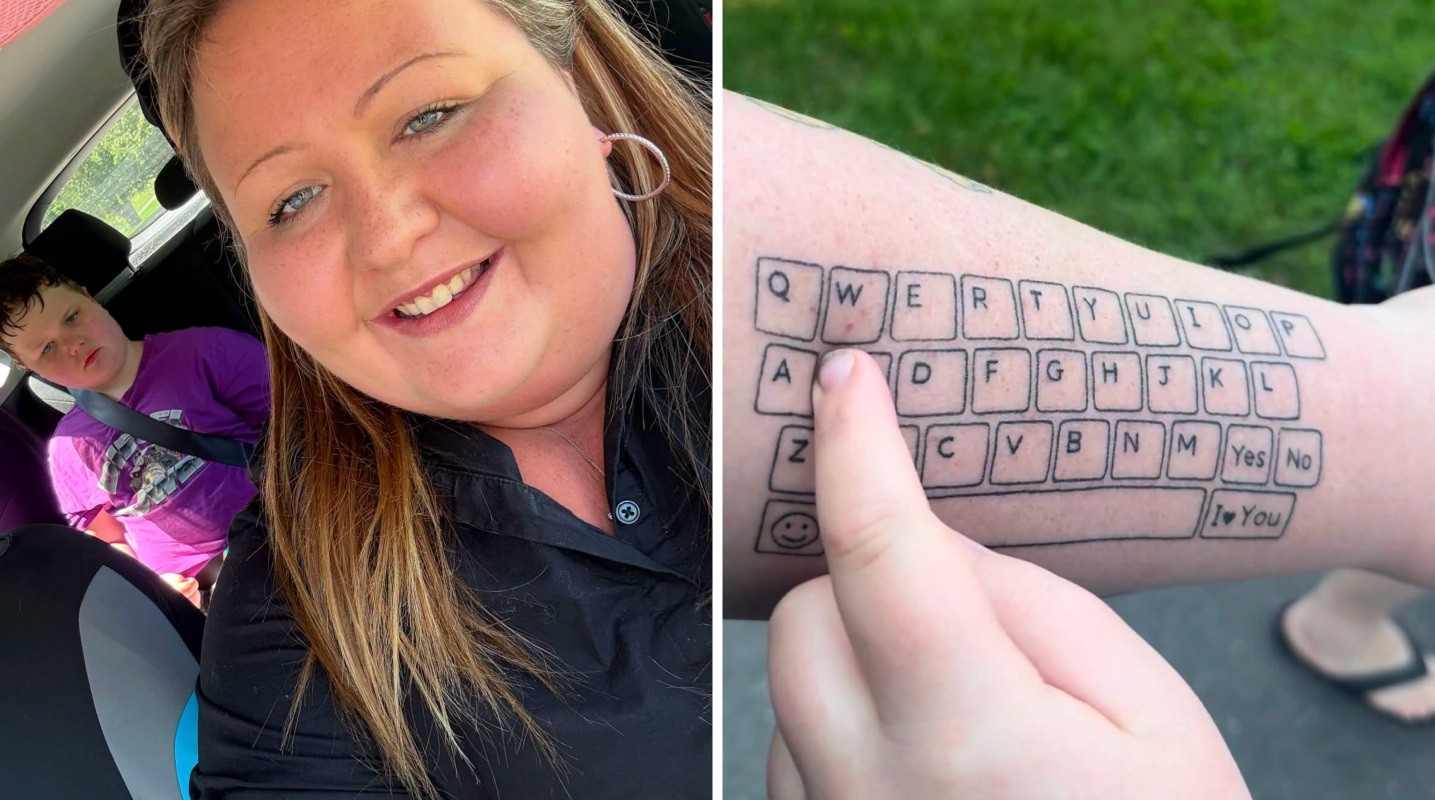
Working with a tattoo artist, she had a QWERTY-style keyboard permanently tattooed onto her forearm so Hunter would always have a way to communicate whenever he was with her.
The tattoo contains letters alongside a happy face, a sad face and an “I heart you” button.
And when Jessica first showed her son what she’d done, Hunter immediately appeared to understand exactly what it was for.
He grabbed his mum’s arm. Then he typed one word: “Mama.”
The tattoo has since become another method of communication between the pair, allowing Hunter to tap the letters on Jessica’s forearm to express what he wants to tell her.
It also offers something his electronic AAC device cannot always provide: a quiet conversation.
While the tablet can speak Hunter’s selected words aloud, the tattoo allows him to communicate directly with his mum without announcing those words to everybody else around them.
It means they can effectively have private conversations through taps on her arm.
Jessica shared a video of Hunter using the tattoo on Facebook on July 8, and the response was enormous.
According to the supplied reports, the footage has been viewed more than 100 million times, while also accumulating more than two million likes across social media.
But for Jessica, the wider attention has provided an opportunity to make a bigger point about communication.
“When we remove communication barriers, we’re giving non speakers the chance to show us who they really are,” she said.
What began with Hunter drawing a makeshift keyboard onto a napkin has since inspired ideas extending far beyond Jessica’s own tattoo.
One particularly touching development came from Hunter’s school friends.
According to Jessica, they wanted keyboards of their own so they could communicate with him in the same way.
His classmates wanted keyboard shirts “so they can talk to him on the playground and be able to whisper and tell their secrets,” Fletcher said.
Jessica subsequently partnered with a clothing company to produce shirts featuring keyboards printed down the sleeve.
The idea means somebody doesn’t necessarily need to permanently tattoo the keyboard onto their skin to make the same form of communication available.
Interest has reportedly come from much further afield too.
Parents, nurses, doctors and first responders from around the world have reached out about using the idea to communicate with autistic children in families, schools and hospitals.
Tattoo artists have also offered to give parents similar keyboard tattoos for free.
It’s an extraordinary evolution for an idea born from an everyday technological failure.
Jessica’s decision involved permanently changing her own body to ensure Hunter had another way of making himself understood.
And given the opportunity, she says she wouldn’t hesitate to make that choice again.
“I’d give my body a thousand scars if it gave my son one more way to communicate,” she said.
For Hunter, that additional way of communicating began with perhaps the most fitting word possible: “Mama.”
Featured image credit: Facebook/Hunter’s Voice
