

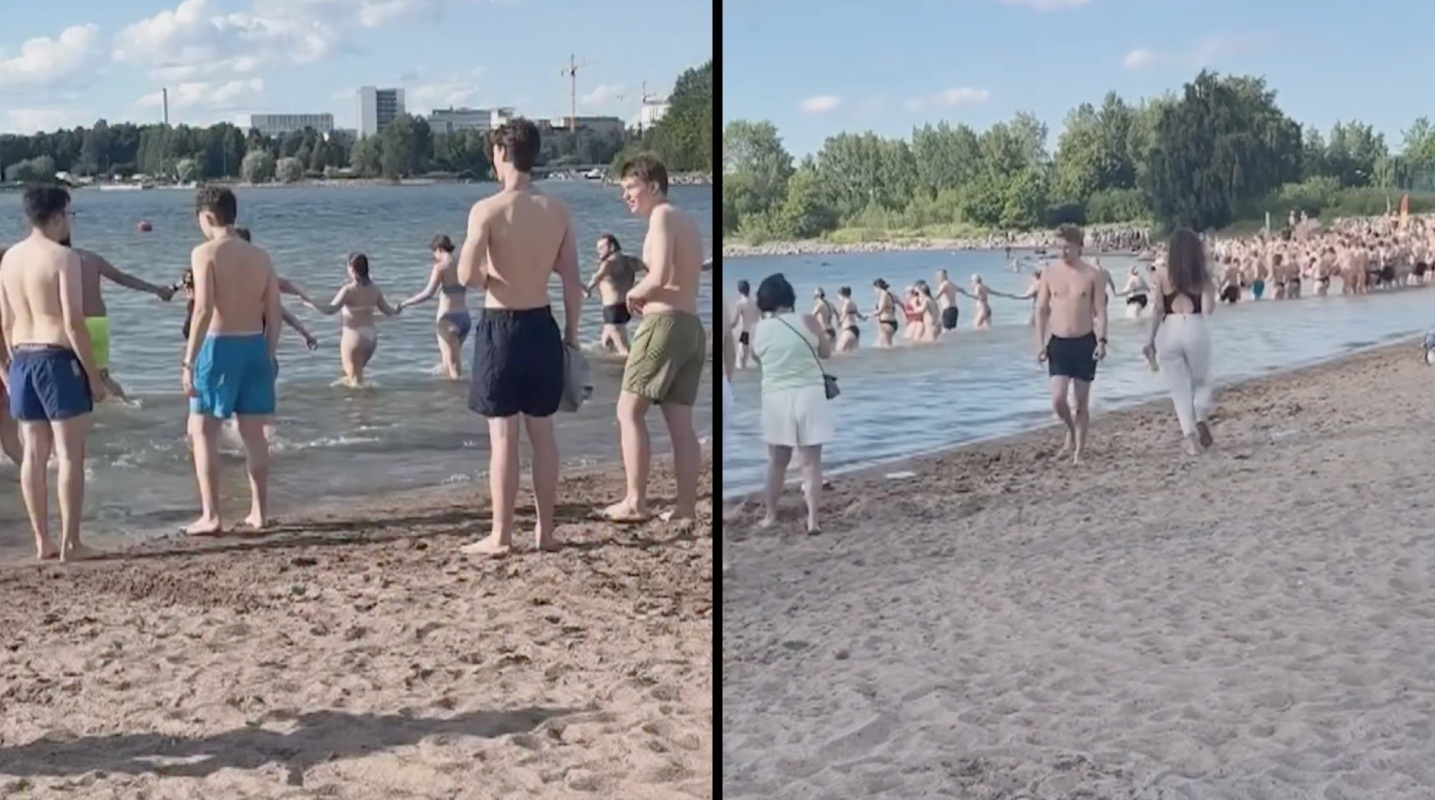
A packed day at one of Helsinki’s most popular beaches quickly turned into a major safety operation after two children went missing and an adult got into difficulty in the water.
Thank you for reading this post, don't forget to subscribe!Crowds had flocked to Hietaniemi beach in July to enjoy one of the warmest days of the year so far, but lifeguards and beachgoers ended up dealing with three separate dangerous incidents, Finnish Broadcasting Company Yle reports.
Thankfully, all three people involved were found unharmed.
Two of the incidents involved girls aged around 10 – both of whom had become separated from their parents or guardians.
And as soon as the alarm was raised, adults on the beach stepped in to help.
According to Jukka Lundgren, a team leader from the City of Helsinki’s sports services, beachgoers formed human chains during both searches in an effort to locate the missing children as quickly as possible.
“In one case the child was in the water, while the other was found on the beach,” Lundgren told Yle.
The situation involving the child in the water was particularly concerning because she was unable to swim.
The response from those around her, however, was immediate.
Local resident Edicarla Salo witnessed one of the searches and later posted a video of the human chain on social media.
She explained that although she could not enter the water herself, she wanted to document what was happening as a reminder of how quickly situations involving children can become dangerous at the beach.
“I can’t swim myself, so I stayed on the beach. I wanted to film the situation to remind people how important it is to take care of children on the beach. Everyone helped, and I wanted to show that too,” Salo said.
According to Salo, lifeguards initially made an announcement instructing everyone to leave the water because children had been reported missing.
Once the water had been cleared, adults who were able to swim were asked to go back in and help with the search.
They did so by holding hands and forming a line through the water, effectively creating a human chain to help cover the area.
The children were found quickly.
Salo praised not only the willingness of ordinary beachgoers to take part, but also the calm response from the lifeguards overseeing the operation. She described their handling of the situation as “absolutely fantastic”.
Lundgren also praised the actions of those who stepped in to assist, as well as the lifeguards and the Swimming Teaching and Lifesaving Federation, which had trained the personnel on duty at the beach.
It proved to be an exceptionally busy day for those responsible for safety at Hietaniemi, which is commonly known to locals as “Hietsu”.
The two missing-child searches were followed by another alarming incident involving an adult who did not know how to swim.
The person had gone too far into the water when the seabed suddenly dropped away beneath them.
“An adult who couldn’t swim went too deep. Suddenly their feet didn’t hit the bottom, and panic set in. So bystanders had to help,” Lundgren explains.
The adult swallowed some water during the incident, but it did not enter their lungs.
Their condition was monitored afterwards and, according to Lundgren, there was no need to call an ambulance.
With all three incidents ending safely, attention then turned to the precautions families should take when spending time near the water.
Lundgren stressed that parents and guardians need to know where their children are at all times, particularly if those children are unable to swim – an important reminder for any beachgoers or lake swimmers around the world.
“It is surprising that a child who does not know how to swim would be allowed to go into the water,” he says.
He also highlighted the importance of swimming ability more broadly.
Lundgren made clear that he did not want to place blame on anyone, but suggested that some people may simply have less familiarity with Finnish lakes and seas than those who have grown up around them.
“They may not have summer cottages to visit, or take part in school swimming lessons,” Lundgren suggests.
His wider message was that learning how to swim can have consequences far beyond simply protecting yourself.
Someone with the right ability may also be in a position to help another person when things go wrong.
“That may even save someone else’s life if you can take the rescue equipment to someone who can’t swim,” Lundgren notes.
The events at Hietaniemi ultimately ended with the best possible outcome.
Both missing girls were found unharmed, while the adult who got into difficulty also escaped without serious injury.
But the sight of adults linking hands and heading back into the water to search for the children offered a striking reminder of how incredible humanity can be.
Featured image credit: X/@EdicarlaSalo
