

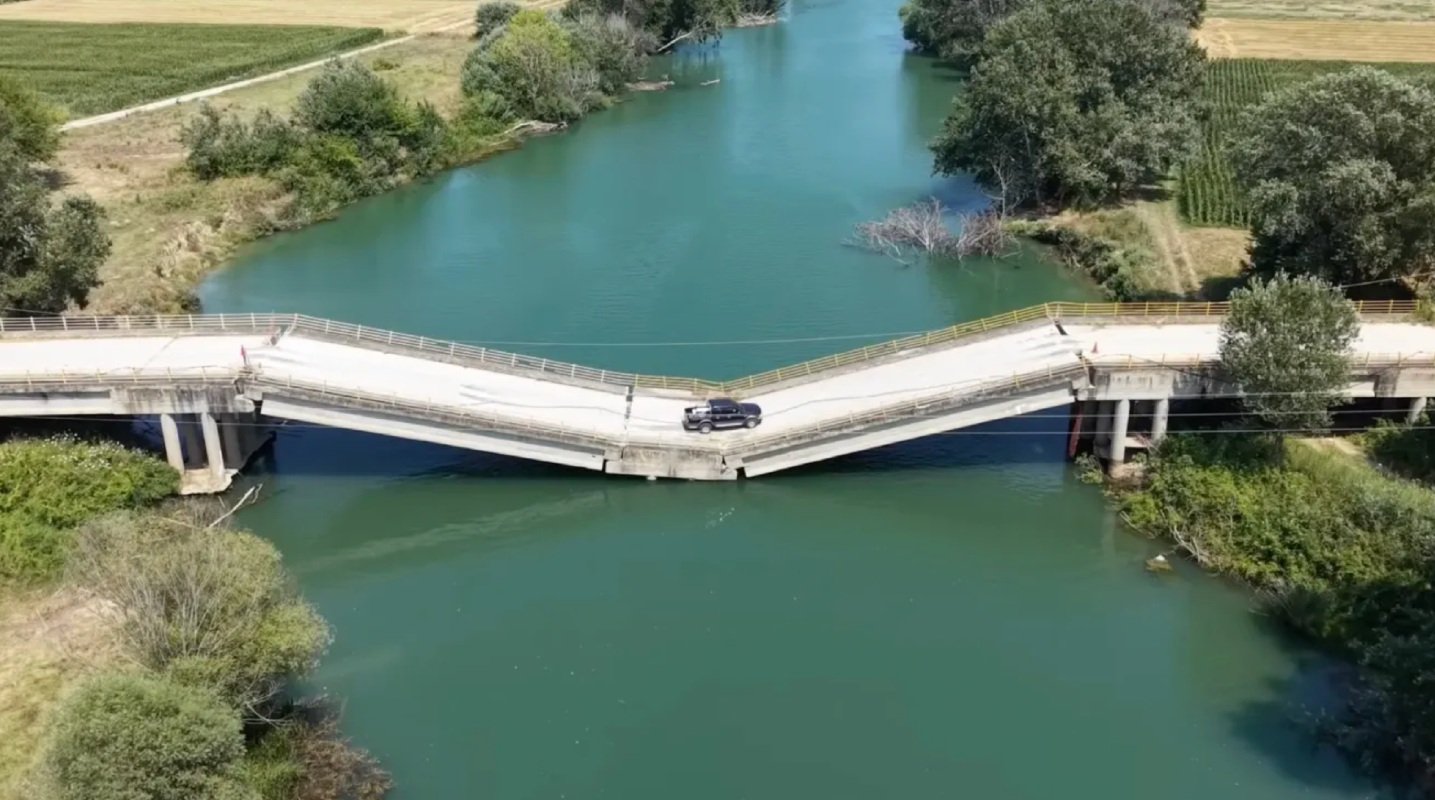
For most drivers, seeing a bridge buckle into the river below would be enough to turn around immediately.
Thank you for reading this post, don't forget to subscribe!But in one part of central Greece, locals continue crossing the damaged structure every day despite it officially being out of service — because the alternative means adding almost 20 miles to their journeys.
The Palaiopyrgos Bridge, which spans the Pineios River and links the villages of Palaiopyrgos and Alexandrini in the Larissa region, has remained visibly deformed since suffering major damage during Storm Daniel in 2023, the New York Post reports.
Although traffic is technically prohibited, motorists continue to drive over the sagging bridge rather than use a lengthy diversion along the national highway.
For many residents, particularly local farmers, the choice comes down to practicality.
“What should we do? Should we go all the way around?” one resident told Greek broadcaster Skai. “Where should we go? Nothing can be done. We play with death every day.”
The bridge has been left in its current condition for around three years after floodwaters eroded the concrete span responsible for supporting traffic.
Instead of collapsing completely, the middle section slumped dramatically towards the river, creating a steep dip while remaining connected to both ends of the crossing.
That unusual damage has meant vehicles are still physically able to cross.
Drone footage shared by local outlet LarissaNet shows drivers carefully navigating the sunken section before climbing back onto the opposite side, despite the obvious structural damage.
According to reports, navigation systems are even continuing to direct motorists towards the crossing.
The bridge’s condition dates back to the devastating impact of Storm Daniel, which swept across Greece, Bulgaria, Turkey and Libya in September 2023.
In Greece alone, the storm claimed 17 lives and caused an estimated $2.14 billion in damage after some areas received an astonishing 750 millimetres of rain in a single day.
The Thessaly region was among the hardest hit, with 79 bridges destroyed during the extreme weather event.
Palaiopyrgos Bridge survived, but only just.
Rather than washing away entirely, the centre of the structure gave way, leaving it suspended in a severely buckled position just above the river.
Despite the obvious dangers, locals say avoiding it creates an even bigger problem.
Yiannis Beritzas, president of the Paleopyrgos village, said the damaged crossing has effectively cut off the most direct route towards Kissavos, forcing motorists onto a detour of up to 19 miles via the national highway.
For farmers travelling daily between fields on opposite sides of the river, that extra distance means additional fuel costs, lost time and greater inconvenience.
While authorities have officially banned traffic from using the bridge, there are reportedly no physical barriers preventing vehicles from accessing it.
There is also little active enforcement stopping motorists from taking the risk.
The continuing use of the crossing has become a growing concern for both local leaders and politicians, who fear the bridge could create an entirely new danger if another major storm strikes the region.
Lawmaker Velopoulos Kyriakos has warned the damaged structure could obstruct the natural flow of the Pineios River during future flooding.
“There a visible risk that in a new Daniel-type storm, where there will be another overflow of the Pinios River, the bridge will act as a dam for the water heading towards the sea, resulting in it overflowing from the riverbeds and flooding the village,” he said in a note addressed to Greece’s infrastructure and transport minister.
Agricultural leaders are also urging officials not to delay further action.
“All traffic is at risk. Let’s not find ourselves running behind the events again,” warned Thanos Hatzizogidis, president of the Paleopyrgos Agricultural Cooperative.
Plans to replace the bridge have reportedly already been approved.
However, despite the project receiving the necessary sign-off, construction has yet to begin, leaving residents with the same difficult decision they have faced for years.
Take the official detour and significantly lengthen every journey, or continue driving across a visibly damaged bridge that could deteriorate further at any time.
For now, many appear willing to accept the risk.
As one resident bluntly summed up: “We play with death every day.”
Featured image credit: LarissaNet via YouTube (screenshot)
