

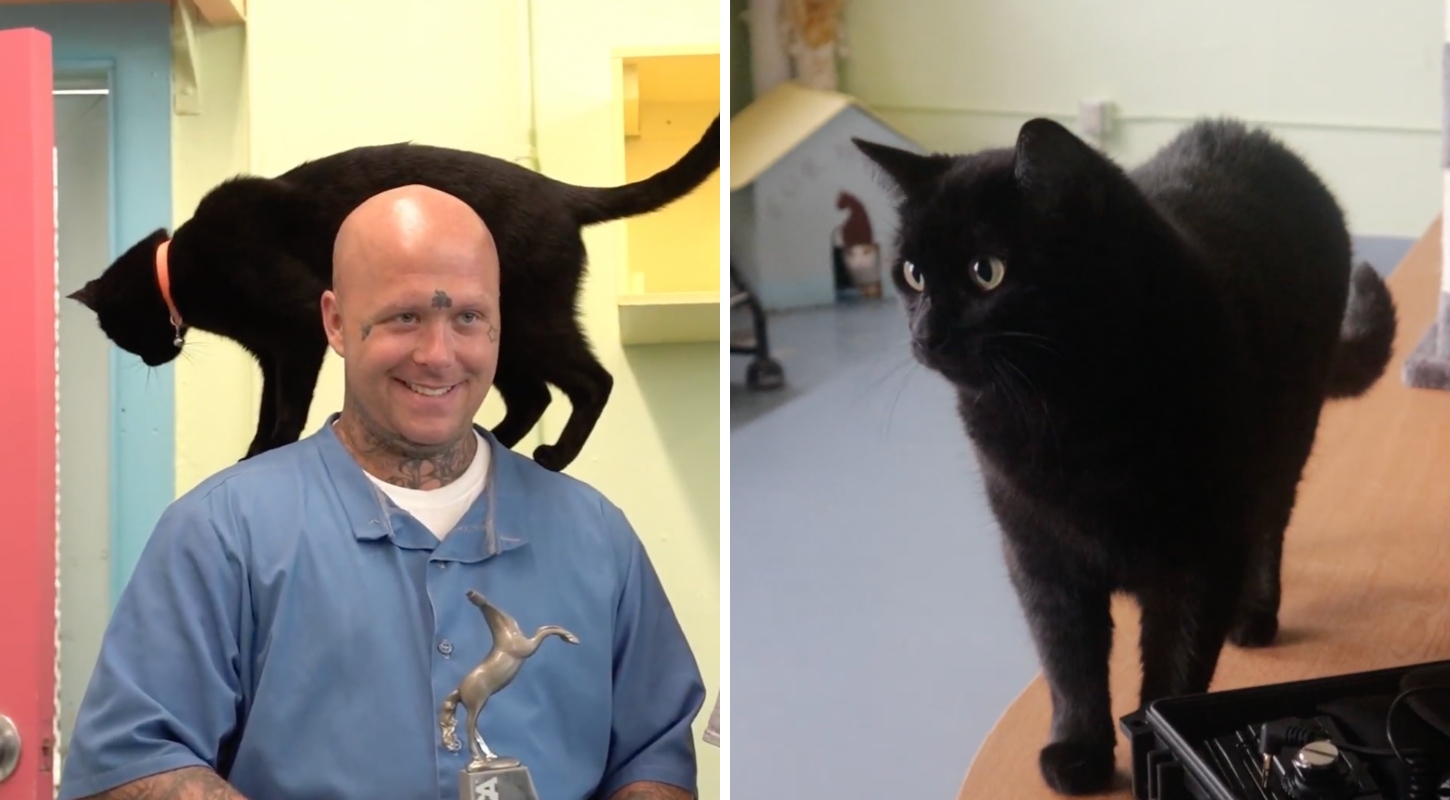
Inside Indiana’s Pendleton Correctional Facility, one of the prison’s most unusual rehabilitation programmes begins with something simple: cats.
Thank you for reading this post, don't forget to subscribe!Abandoned, abused and homeless shelter cats are being brought into the prison as part of the facility’s FORWARD programme, where incarcerated men help care for them while also working on rebuilding themselves.
What started as an animal care initiative has quietly become something much bigger.
The programme, which has been running since 2015, partners with the Animal Protection League in Anderson, Indiana, and gives prisoners the responsibility of feeding, cleaning, monitoring and socialising cats that are later made available for adoption.
For many involved, it has become deeply personal.
Anthony Larusa, who has worked with the programme since late 2017 or early 2018, admitted he never expected cats to change his outlook on life.
“These are cats that are just — it might be abandoned, abused, just feral, just left on the streets or whatever and they’re brought here for us to rehabilitate them as well as we’re rehabilitating ourselves,” he explained. “It’s a dual thing.”
Larusa said he entered prison struggling mentally after receiving a 40-year sentence: “I was lost. I didn’t know what I was going to do. I was kind of like in depression.”
He initially volunteered to help clean the area before eventually being offered a permanent role working directly with the cats.
“I’ve never had a cat. I wasn’t a cat person really,” he admitted. “I’m like sure, I’ll try it — and here I am today.”
Years later, Larusa has become one of the programme’s most dedicated caretakers, creating detailed systems to track every cat in the facility.
Each animal has its own profile complete with photographs, breed information, weight records and behavioural notes.
“We weigh them every month,” he said. “Every cat in here has that.”
The level of organisation reflects how seriously the inmates take the responsibility.
Larusa explained that caring for the cats has become part of his daily routine from morning until evening, sometimes even overnight if an animal becomes ill.
“If they got a sick cat or a hurt cat or anything that I have to come and check on, I’ll come a couple of hours throughout the night just to check on them,” he said.
Staff at the facility support the programme closely, even accompanying him during late-night visits when medication or monitoring is needed.
Over time, Larusa began doing far more than simply feeding or cleaning up after the animals.
He started writing biographies for each cat to help future adopters better understand their personalities.
“I gave them a voice,” he explained. “If they go on the website and you see Bowie or you see Pepper or Priest or something like that, you actually get to know them by their little cat bio because I wrote it in what I see through them every day.”
The cats themselves have become familiar characters inside the prison walls.
Larusa described one named Steve as “the protector,” while another called Jinxy Girl is “real skittish.”
Others, including Athena and Nyx, arrived together and quickly formed close bonds.
“That would be really cool if them two was able to be adopted out at the same time,” he said. “Because they know each other.”
The emotional impact of the programme has stretched far beyond the cat room itself.
Larusa said incarcerated men from across the prison regularly visit simply to spend time with the animals.
“There are guys who have been down 15, 20 years [who] haven’t pet not one animal,” he explained. “So when they come to the building, and they see it, it’s pretty amazing to be able to allow somebody who hasn’t pet an animal that long to be able to give him the opportunity for that.”
For some inmates, the experience has reintroduced affection, patience and emotional connection into lives where those things have long disappeared.
Sergeant Reinhardt, who has worked with the cats since shortly after they first arrived at Pendleton in 2015, believes that transformation is central to the programme’s success.
“We take care of them,” she said. “We try to teach the offenders how to care for something that can’t care for themselves.”
She added that many prisoners arrive without ever having experienced healthy unconditional relationships.
“A lot of the time they learn what it is to be loved without any conditions and to love back,” Reinhardt explained. “And I don’t think a lot of them have experienced that in their lifetime.”
According to Reinhardt, the behavioural changes among participants are visible.
“You can see the change in them,” she said. “And it’s a good change.”
The cats benefit too.
Many arrive from difficult situations before eventually being rehabilitated and adopted into permanent homes.
The programme works directly with the Animal Protection League in Anderson, where potential adopters can apply online for the cats currently housed at the prison.
Adoption fees include vaccinations, microchipping and veterinary visits.
Donations also help sustain the programme, with items such as blankets, toys and cat trees regularly needed.
Larusa believes the initiative should expand into correctional facilities across the country.
“It’s given me an opportunity to understand that it’s not just about me,” he said. “It gives me the opportunity also to care for something other than myself.”
He added that the experience has helped him think differently about his own children and the future he hopes to build after prison.
“I have kids, but since I’m incarcerated, I don’t actually get to spend that time with them,” he said. “So this gives me a chance to understand like, ‘Hey, somebody else needs me,’ so when I go home I can actually care for my kids as well.”
The programme has already gained outside recognition, including an award connected to the ASPCA — something Larusa described as “huge.”
But for him, the biggest reward remains far simpler.
Every morning when he walks into the cat room, the animals wait by the door for him.
“They know that you’re coming in,” he said. “They want food, they want treats, they want loving.”
After years inside prison walls, those small moments have become a reminder that rehabilitation can sometimes begin in the most unexpected places.
And for the cats waiting to be adopted, it may have given them a second chance too.
Featured image credit: Indiana Department of Correction / YouTube (screenshot)
