

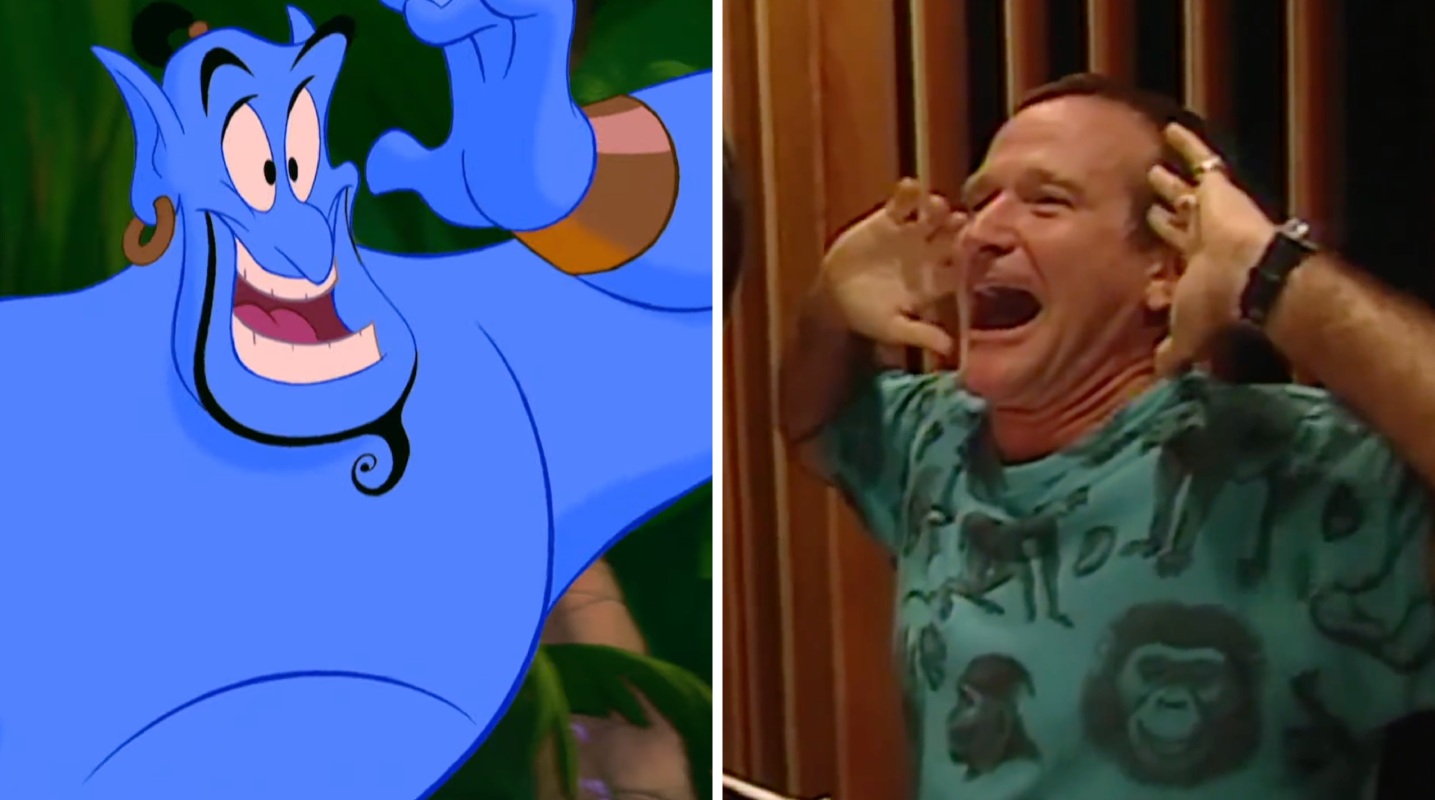
Robin Williams could have asked Disney for millions to voice Genie in Aladdin.
Thank you for reading this post, don't forget to subscribe!Instead, he accepted a tiny fraction of his usual salary for one surprisingly emotional reason.
More than three decades after Aladdin first hit cinemas, Williams’ performance as the fast-talking blue Genie is still widely viewed as one of the greatest voice acting performances in movie history.
The role became completely inseparable from the late actor’s chaotic energy, improvisation, warmth, and humour.
But despite being one of Hollywood’s biggest stars at the time, Williams reportedly accepted just $75,000 for the part — dramatically lower than the roughly $8 million fee he would normally command for major movie roles, according to Business Insider.
And it turns out money was never the reason he took the job in the first place.
Williams, who tragically passed away by suicide in 2014 at the age of 63, explained in multiple interviews that his motivation for joining Disney’s animated classic was far more personal.
In a 1993 interview with New York Magazine, the father-of-three revealed he agreed to the role because he wanted to become part of animation history and “leave something wonderful behind” for his children.
That idea mattered more to him than a massive payday.
And judging by the generations of children who grew up still quoting Genie’s lines, it’s safe to say he succeeded.
Williams also revealed he went far beyond what Disney originally expected while recording the role.
According to the actor, he left the studio with roughly 30 hours of additional improvised material for animators and editors to work with.
That freedom to improvise became a huge part of why Genie felt so different from almost every other animated character audiences had seen before.
Years later, Williams described the recording process during an interview with TV Guide USA.
“I went into a room and started improvising, and these guys kept throwing ideas at me. It just got wild. They let me play.” He added: “That’s why I loved it – it was like carte blanche to go nuts. Of course, there were times when I’d go tasteless, when I knew the mouse was not going to approve: ‘Oh, come on, boy. Rub the lamp, the big spout. Don’t be afraid!'”
However, despite accepting a far smaller salary, Williams did have one major condition attached to the deal.
He did not want Disney using his voice to aggressively market merchandise connected to the movie.
“I don’t want to sell stuff,” Williams said in comments reported by Screen Rant. “It’s the one thing I don’t do.”
He later expanded on that stance during an interview with the Today Show, saying: “The one thing I said was I will do the voice. I’m doing it basically because I want to be part of this animation tradition. I want something for my children. One deal is, I just don’t want to sell anything — as in Burger King, as in toys, as in stuff.”
That agreement would eventually become the centre of a major fallout between Williams and Disney after Aladdin became a global phenomenon.
Williams later accused the studio of using Genie — and by extension, his voice — too heavily in marketing campaigns and merchandise promotions tied to the film.
Speaking to the Toronto Sun in 1996, the actor explained that the issue had been over “merchandising tie-ins, the whole thing.”
“I don’t mind if they make dolls,” he said. “It’s when they use my voice that it gets interesting.”
The disagreement became serious enough that Williams refused to return for the 1994 sequel, The Return of Jafar, where Genie was instead voiced by Dan Castellaneta — best known as the voice of Homer Simpson.
At one point, Disney reportedly attempted to smooth tensions by gifting Williams a Picasso painting said to be worth around $1 million.
But according to Williams, the famous artwork arrived before the relationship completely broke down.
“The thing is they didn’t give me a Picasso as a payback for violating the agreement. The Picasso came first, then they violated the agreement, then we broke off the marriage. Then they apologized, and that was all I wanted.” He continued: “I wanted them to say, ‘We violated the agreement and then we put out a press campaign that made it look as if you were sticking us up for money.’ Studios do this all the time, but they just don’t cop to it. (He adopts a voice): ‘Shhh! You mean lie?’ But they did and they admitted it and now we’re back.”
Williams also joked about how strange the feud became for his family life.
“It was tough for a while. How do you tell the kids, ‘Daddy’s fighting with Disney, so we won’t be going to Orlando for a while? No more plush toys or Hunchback packs or merchandising.'”
Disney, however, publicly disputed parts of Williams’ version of events.
According to the LA Times, a Disney spokesperson responded by saying: “Every single piece of marketing material involving Robin Williams was run by Marsha (the actor’s wife) and Robin Williams. We did not use his voice in any way that he did not contractually agree to.”
The spokesperson added: “He agreed to the deal, and then when the movie turned out to be a big hit, he didn’t like the deal he had made.”
Fortunately, the relationship between Williams and Disney eventually recovered.
The actor later returned to voice Genie once again in the third Aladdin film in 1996, reuniting audiences with one of the most beloved animated characters ever created.
Additionally, for Disney’s 100-year celebration in 2023, Walt Disney Animation Studios released a short movie titled Once Upon A Studio, celebrating characters from the past and present. As part of the movie, William’s was able to posthumously return as Genie thanks to unearthed unused recordings. You can check it out below:
Genie remains one of the clearest reminders of what made Robin Williams so special.
Not just because he was funny. But because even at the peak of his fame, he was still thinking about creating something magical his children – and in doing so, children all over the world – could hold onto forever.
Featured image credit: WaltDisneyStudios/Aladdin/YouTube/EntertainmentTonight (screenshots)
