

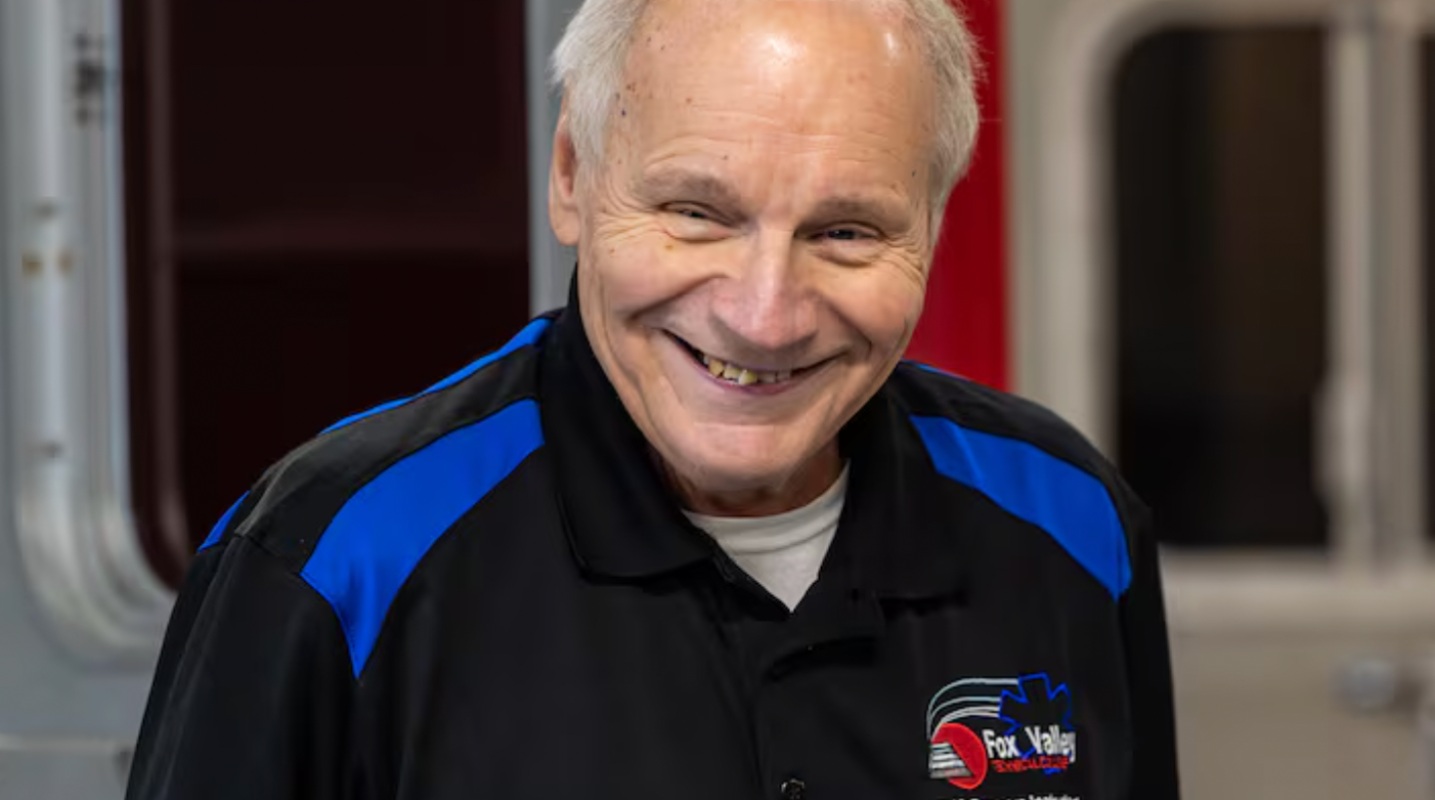
What started as a routine training session quickly turned into a real-life emergency that no one in the room will ever forget.
Thank you for reading this post, don't forget to subscribe!Karl Arps, a 72-year-old EMT instructor, was mid-lesson at Fox Valley Technical College in Appleton, Wisconsin, demonstrating the signs of a heart attack when the unthinkable happened — he suffered one himself.
IIn a matter of seconds, the controlled environment of a lesson flipped into a genuine life-or-death situation.
Arps later explained that everything after that moment is a blur.
“From what I was told, they did everything like we told them to do in CPR class,” he told As It Happens host Nil Köksal, via CBC.
“Thank you does not seem enough. They saved my life, period.”
For the students, the shift from training to reality was immediate — and instinct took over.
Logan Lehrer, a firefighter who was training as an EMT, was one of the first to realise something wasn’t right. Watching closely, he noticed physical signs that didn’t match a demonstration – Arps’ hand had curled, his face contorted, and he started snoring.
At first, there was a brief moment of uncertainty — the kind that comes when you question whether this might still be part of the exercise.
Lehrer’s immediate thought was that Arps was perhaps performing some sort of test for the students. But it quickly became apparent that it wasn’t the case.
The students quickly brought in another instructor, Traci Blondeau, who attempted to “snap him out of it” before realising the situation was serious. From there, the response kicked in exactly as they had been trained.
“That’s immediately when we started responding to the situation,” Lehrer said.
Lehrer called 911, while the rest of the group began administering CPR and preparing a defibrillator. In total, six students worked together, rotating roles and maintaining focus under intense pressure. Despite the chaos of the moment, their execution was calm and coordinated.
“We all had our tasks, and we all knew what to do,” Lehrer said. “There was not a student out there that was fumbling.”
Within minutes, first responders from Gold Cross Ambulance and Greenville First Responders arrived — but by then, the life-saving groundwork had already been done.
Nick Romenesko, executive director of Gold Cross Ambulance, confirmed just how important those early moments were. “The early recognition that Karl was in cardiac arrest, along with the immediate actions taken by FVTC students and staff, directly contributed to Mr. Arps’s positive outcome,” he said.
In situations like this, timing is everything. Survival rates for cardiac arrest outside of hospital settings are typically low, per the British Heart Foundation, but rapid intervention — especially CPR and defibrillator use — can dramatically improve outcomes.
In this case, the students’ actions made all the difference.
Arps later underwent triple-bypass surgery and made a remarkable recovery — something he admits is rare, even with his decades of experience.
“I’ve been in practice for a quarter of a century, and I can count the number of CPR saves that I’ve had on one hand. [Sometimes] we get a pulse back in the ambulance or on scene, but the person ends up passing away two or three days later in the hospital,” he said. “I had a heart attack, I had the surgery, and I walked out of that hospital seven days later.”
Now on the road to recovery, Arps has already returned to the college to personally thank the students who stepped in when he needed them most.
“I was able to give each one of my students a life-saving pin that the college provided and give them a little sugary treat that I brought in saying thank you,” he said.
“I often think, are they just taking up space in this classroom, or are they actually listening? Well, now I know they’re actually listening and they’re paying attention,” Arps added. “And thank God that they were there.”
Featured image credit: Instagram/Fox Valley Technical College
