

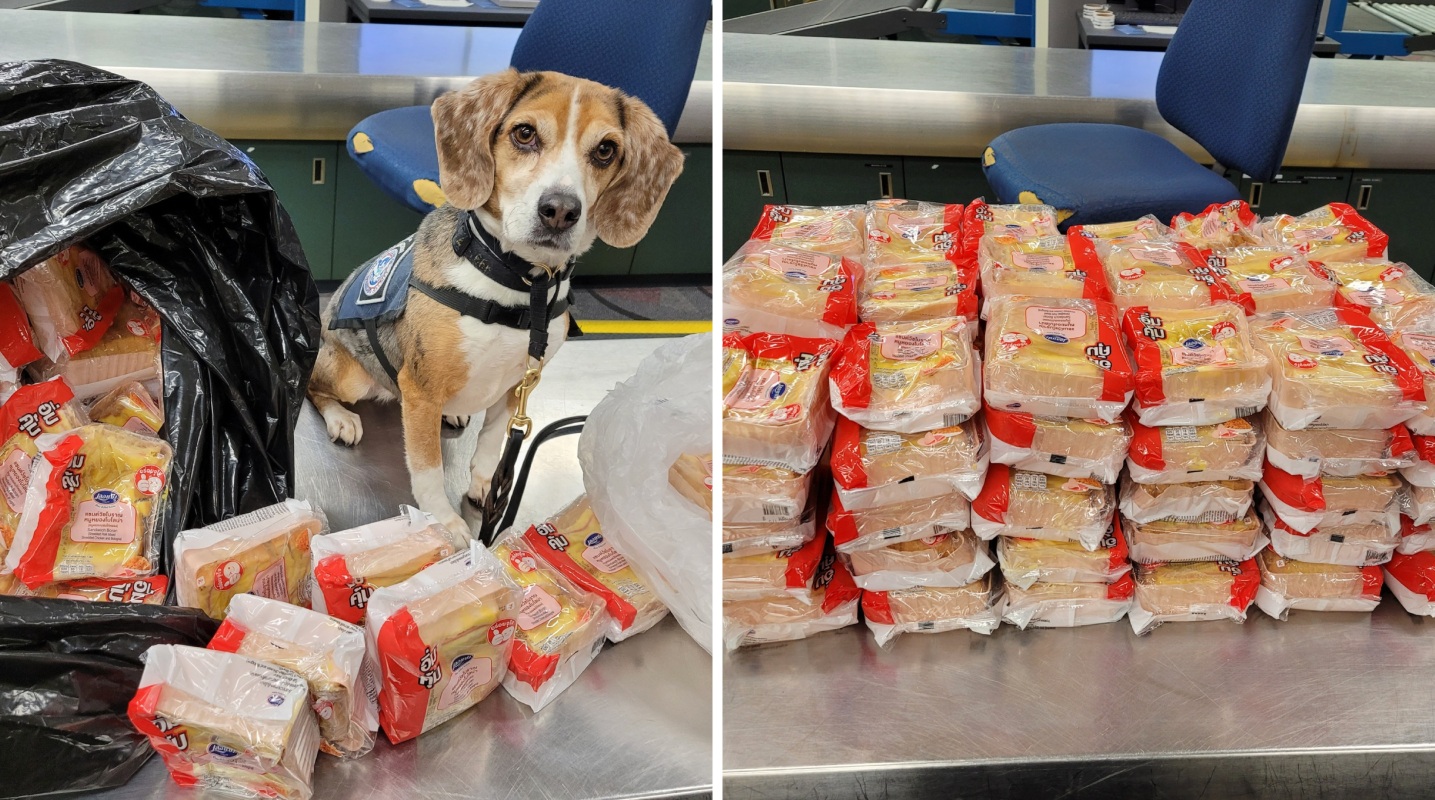
Trying to sneak snacks through airport security is one thing. But trying to sneak over 100 sandwiches through international customs is another entirely.
Thank you for reading this post, don't forget to subscribe!That’s exactly what one traveller attempted — only to be stopped by a four-legged officer with a nose for trouble.
A sniffer dog working with U.S. Customs and Border Protection (CBP) made the unusual discovery after detecting a suspicious scent coming from a passenger’s luggage. Inside, officers found more than 100 pork and chicken sandwiches from 7-Eleven in Thailand, carefully packed into two large bags.
The dog behind the find? A beagle named Merla.
And while the haul might sound bizarre, officials were quick to remind people that this wasn’t just about food — it was about protecting agriculture.
“Though it might be stale at this point, lettuce remind you that you must declare agriculture items (including meats!) when entering the US,” the CBP Office of Field Operations said in a statement on Facebook. “CBP K9 Merla discovered 100 pork and chicken sandwiches in luggage. All were destroyed.”

Yes — all of them. Which breaks my heart a little.
Despite some online reactions questioning why the sandwiches couldn’t simply be kept or eaten, there’s a strict reason behind the rule.
Bringing meat products into the United States from abroad is prohibited due to the potential risks they carry.
According to authorities, “prohibited agricultural items can harbor plant pests and foreign animal diseases that could seriously damage America’s crops, livestock, and the environment.”
In other words, even something as harmless-looking as a sandwich could pose a serious threat if it introduces disease or contamination. That’s why all travellers are required to declare items such as meats, fruits, vegetables, plants, seeds, and animal products when entering the country — whether they’re in checked luggage, carry-ons, or even vehicles.
Failing to do so doesn’t just result in confiscation.
First-time offenders can face fines of up to $1,000 for non-commercial quantities, with harsher penalties possible for larger or commercial-scale attempts.
And while 100 sandwiches might sound excessive, it’s exactly the kind of situation detector dogs are trained for.
The CBP’s detector dog programme — often referred to as the “Beagle Brigade” — has been in operation since 1984 and now includes over 180 teams. These dogs are specifically trained to identify banned food items using their highly sensitive sense of smell.
Beagles, in particular, are well suited to the role thanks to their size, temperament, and strong food motivation.
In this case, Merla did exactly what she was trained to do.
And while the discovery sparked plenty of humour online, some were quick to highlight the bigger picture.
“It’s funny, but this is actually serious because one contaminated food item can affect an entire country’s agriculture,” one user commented. “Still, finding 100+ sandwiches is wild, that dog deserves a raise.”
Another added: “Merla is out here saving America one 7-Eleven sandwich at a time.”
One Facebook user asked: “You saying you didn’t give that dog even one?”
And this person perhaps summed it up best: “Thank you for removing such dangerous contraband from society. I can now eat my McDonald’s with peace of mind.”
Featured image credit: Facebook/CBP Office of Field Operations (screenshots)
