

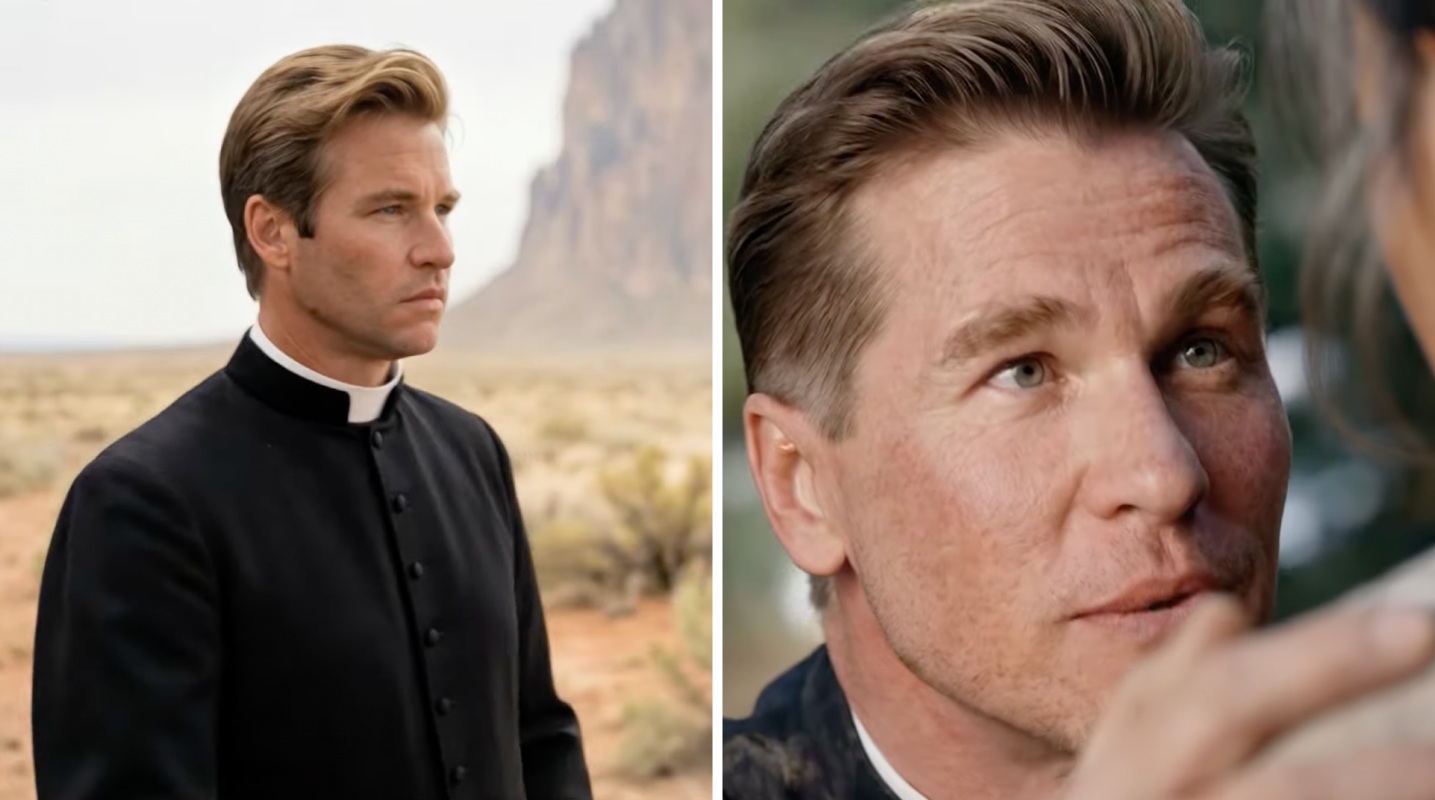
More than a year after his passing, Val Kilmer is back on screen — not through lost footage or a cameo, but through cutting-edge artificial intelligence that’s already sparking debate across Hollywood.
Thank you for reading this post, don't forget to subscribe!The late actor’s digitally recreated likeness features prominently in the first trailer for As Deep as the Grave, a historical drama unveiled at CinemaCon in Las Vegas. And for many watching, it’s a surreal moment — seeing a performance that almost never happened brought to life in a completely new way.
Kilmer – who died on April 1, 2025, at the age of 65 following a long battle with throat cancer – had originally been cast in the film years earlier. However, his declining health meant he was unable to shoot his scenes at the time.
Rather than recast the role, filmmakers made a bold decision — one that would ultimately define the project.
With the full approval of Kilmer’s estate, including his daughter Mercedes, the production used generative AI and archival material to complete his performance, effectively allowing him to appear in the finished film despite never stepping onto set, Variety reports.
And this isn’t a minor cameo.
According to the filmmakers, Kilmer appears on screen for more than an hour, portraying Father Fintan — a Catholic priest and Native American spiritualist.
In the trailer, his character delivers a haunting line that immediately grabbed attention: “Don’t fear the dead, and don’t fear me.”
The footage itself moves through different phases of Kilmer’s life, also showing him as a younger man.
The film, directed by Coerte Voorhees, follows real-life archaeologists Ann and Earl Morris as they uncover the remains of the Ancestral Puebloans in the 1920s. It stars Abigail Lawrie, Tom Felton and Abigail Breslin, but it’s Kilmer’s presence that has quickly become the focal point of conversation.
And understandably so. The trailer for the movie has ingnite a multitude of comments.
“Fascinating. It’s not Val Kilmer, it just looks like him, yet his name is in the cast. Sets a very strange precedent. If this becomes the norm, our whole sense of who we are and what defines a person’s identity is gonna be all out of whack,” one person commented.
A second added: “This is a mix of decent made shots and AI slop to fill the rest of the runtime. I can’t believe some big actors signed their name to the project. If this is the future of filmmaking, cinema is dead.”
And a third wrote: “I hope people won’t go see this movie for the AI use and thus will bring in no money and in turn stop studios from doing this stuff.”
The use of AI to recreate a deceased actor raises difficult questions — not just about technology, but about consent, legacy, and the future of performance itself. And the filmmakers have been keen to address those concerns head-on.
Speaking at CinemaCon, Voorhees stressed the care taken throughout the process, explaining that Kilmer’s family was closely involved every step of the way.
“Val Kilmer influenced this performance,” he said.
Producer John Voorhees acknowledged the complexity of what they were doing, describing it as “risky territory,” but insisted the production followed strict SAG-AFTRA guidelines centred on “consent, compensation and collaboration.”
Kilmer’s estate was not only consulted but compensated, and also provided the archival materials used to build the performance — something the filmmakers say was essential to ensuring authenticity.
That support from his family was crucial.
“We were so glad they were so excited and so supportive of the idea,” Voorhees said. “We didn’t want to do it unless everybody thought this was going to work properly.”
Mercedes Kilmer also offered insight into why the decision felt right, suggesting it aligned with her father’s own outlook on technology.
“He always looked at emerging technologies with optimism as a tool to expand the possibilities of storytelling,” she said. “This spirit is something that we are all honoring within this specific film, of which he was an integral part.”
This is not the first time that Kilmer has been able to return to the big screen thanks to technological advances in the industry. After losing his natural voice due to throat cancer, he had already embraced AI during his lifetime, working with software to recreate his voice — technology that was later used in Top Gun: Maverick.
That history adds another layer to what audiences are now seeing — not just a digital recreation, but a continuation of an approach Kilmer himself had already begun exploring.
Production on As Deep as the Grave began back in 2020 in New Mexico but faced delays during the pandemic. When Kilmer could no longer participate, the team chose patience over replacement, eventually returning to the project with a new solution.
Now, that decision has resulted in one of the most talked-about trailers of the year.
Featured image credit: YouTube/FirstLineFilms (screenshots)
