

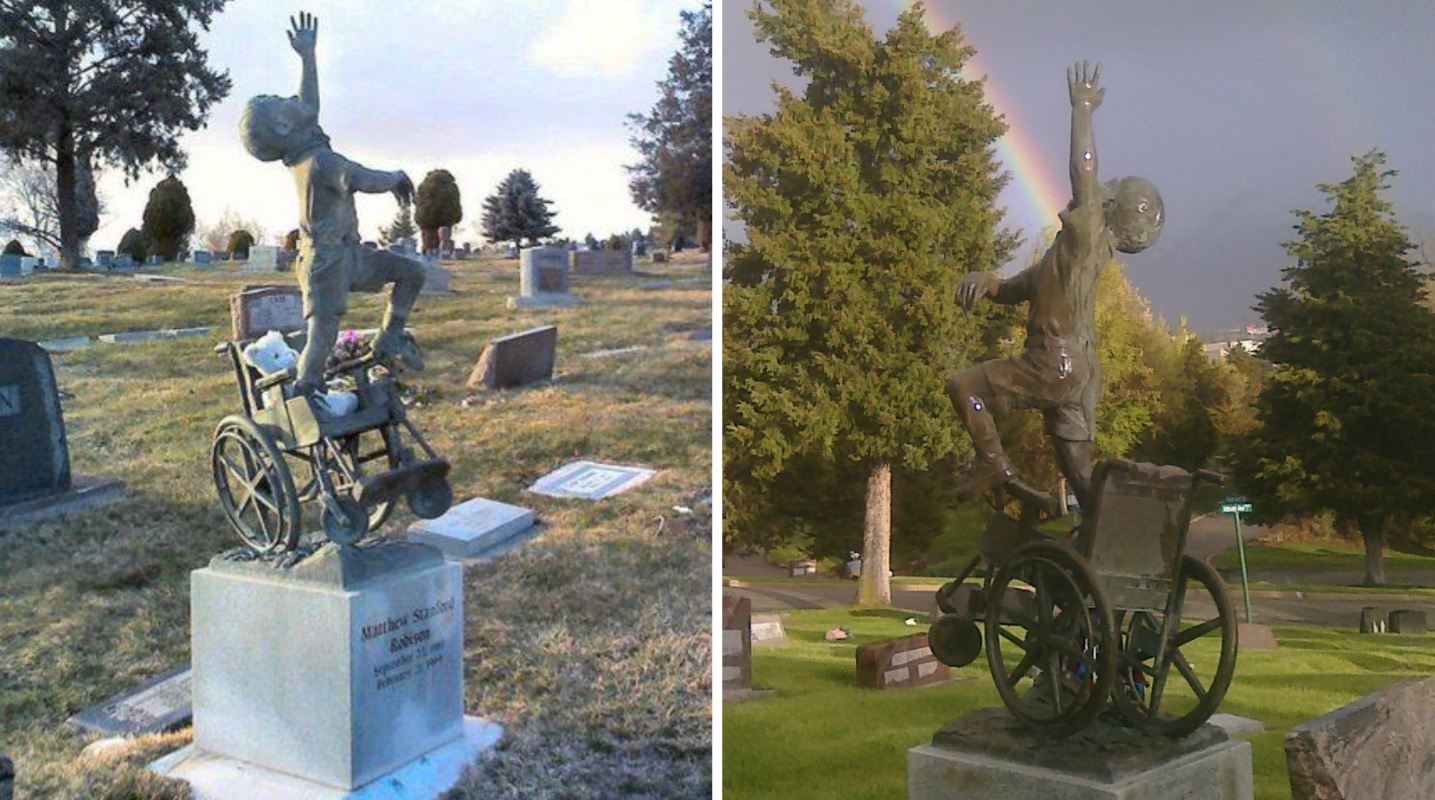
Among more than 100,000 memorials spread across the Salt Lake City Cemetery, one stands out — not for its size, but for the emotion it captures in a single moment.
Thank you for reading this post, don't forget to subscribe!It doesn’t just mark where a child is buried. It tells a poignant story of a remarkable young boy and a father’s unyielding love.
Matthew Stanford Robison died at just 10 years old, but more than two decades later, his legacy continues to reach people across the world — largely because of the monument his father created in his honour.
At first glance, the gravestone is simple: a square piece of granite bearing his name and the dates of his short life. But above it sits something far more powerful.
A bronze sculpture of a young boy lifting himself out of a wheelchair, reaching upward as if ascending — leaving behind the physical limitations that defined his life on Earth.
For Matthew’s father, Ernest Robison, every detail carries meaning.
“I wanted to do it as a tribute to him and other kids that are like him,” Robinson explained to ABC4.
Matthew was born with severe disabilities caused by oxygen deprivation at birth. He was cortically blind and deaf, unable to sit up on his own, and couldn’t eat solid food. Doctors initially believed he wouldn’t survive more than a few hours.
But, amazingly, he lived for 3,804 days.
And in that time, he left a lasting impression on everyone around him.
“He just loved people,” Robison says. “When he was around people, he would smile. Even though he couldn’t talk or move, you just knew he loved to be around people.”
That love was returned in equal measure.
At school, classmates would bring their parents to meet him, eager to introduce them to someone who had become such an important part of their lives.
“He was just one of them, one of their friends,” Robison recalls.
Despite the challenges his family faced — caring for a child with complex needs around the clock — Matthew’s presence shaped not only their lives, but the lives of others too.
Even influencing changes that helped children with disabilities integrate into traditional school environments.
When Matthew passed away in 1999, his father — an artist and biomedical engineering expert — knew he wanted to create something that reflected more than loss.
He wanted to capture freedom.
“I came up with the idea of a little boy climbing out of his wheelchair with his hand up toward Heaven, and just leaving his wheelchair behind and going up to Heaven,” Ernest told Fox13.
The result was something that resonated far beyond the family.
When the sculpture was first taken to a foundry to be cast in bronze, workers reportedly stopped what they were doing, drawn to the emotion behind the piece.
“And they just looked at it and looked at it, and I thought, ‘Whoa, what have I done?’ I never ever thought that this would have such an impact on people. It had a great impact on us,” Ernest said.
He was right. Over the years, the monument has repeatedly gone viral online, shared across platforms like Reddit and Instagram, drawing visitors from across the country who come to see it in person.
“Every week I get people inquiring about it,” Robison says. “A couple of people are doing statues like that with their family. People show such an interest in it.”
For Matthew’s mother, Anneke, the site has transformed from a place of grief into something entirely different.
“It’s an enjoyable place to come,” she said. “Because I see that every time I go there, my son is happy, and running and jumping and smelling flowers, and doing all the things a young boy can do, and he’s doing it in heaven. Before, it wasn’t a pleasant place to be at the gravesite. Now, it’s a joy to go and get the feeling that he’s happy.”
The monument’s impact doesn’t end at the cemetery gates.
Matthew’s legacy lives on through Ability Found, a nonprofit founded by his family that provides customised mobility and adaptive equipment to people with disabilities.
Born out of the same challenges they faced raising Matthew, the organisation now helps thousands each year — offering practical support and, for many families, a sense of hope.
“A lot of times, and I learned with Matthew, you’d get a piece of equipment but it wasn’t customized or right for them and didn’t do the job it should have done,” Ernest explained. “So we’ve been really able to help people over the years.”
For families going through similar experiences, the message is simple — and hard-earned.
“It’s very, very hard to have a child that needs constant care, all day, at night, seven days a week. It just wears you out,” Ernest said.
But there is a way through, and he wants parents to know “you can do it one day at a time.”
“That’s the thing you have to remember,” Anneke added.
More than 20 years on, the monument remains what it was always intended to be — not just a tribute, but a symbol. Of release. Of peace. Of a life that, while short, continues to move people long after it ended.
To his father, though, the memory of Matthew is far simpler — and far more personal:
“He was a perfect person. I don’t know of anything he did wrong. When he was sick or had problems, he never lost his patience or complained to us or anything like that. He was just really, really loving and an exceptional little boy.”
Check out Ability Found on Facebook, and stay up-to-date with all the amazing work they’re continuing to do for families.
Featured image credit: Facebook/Ability Found
