

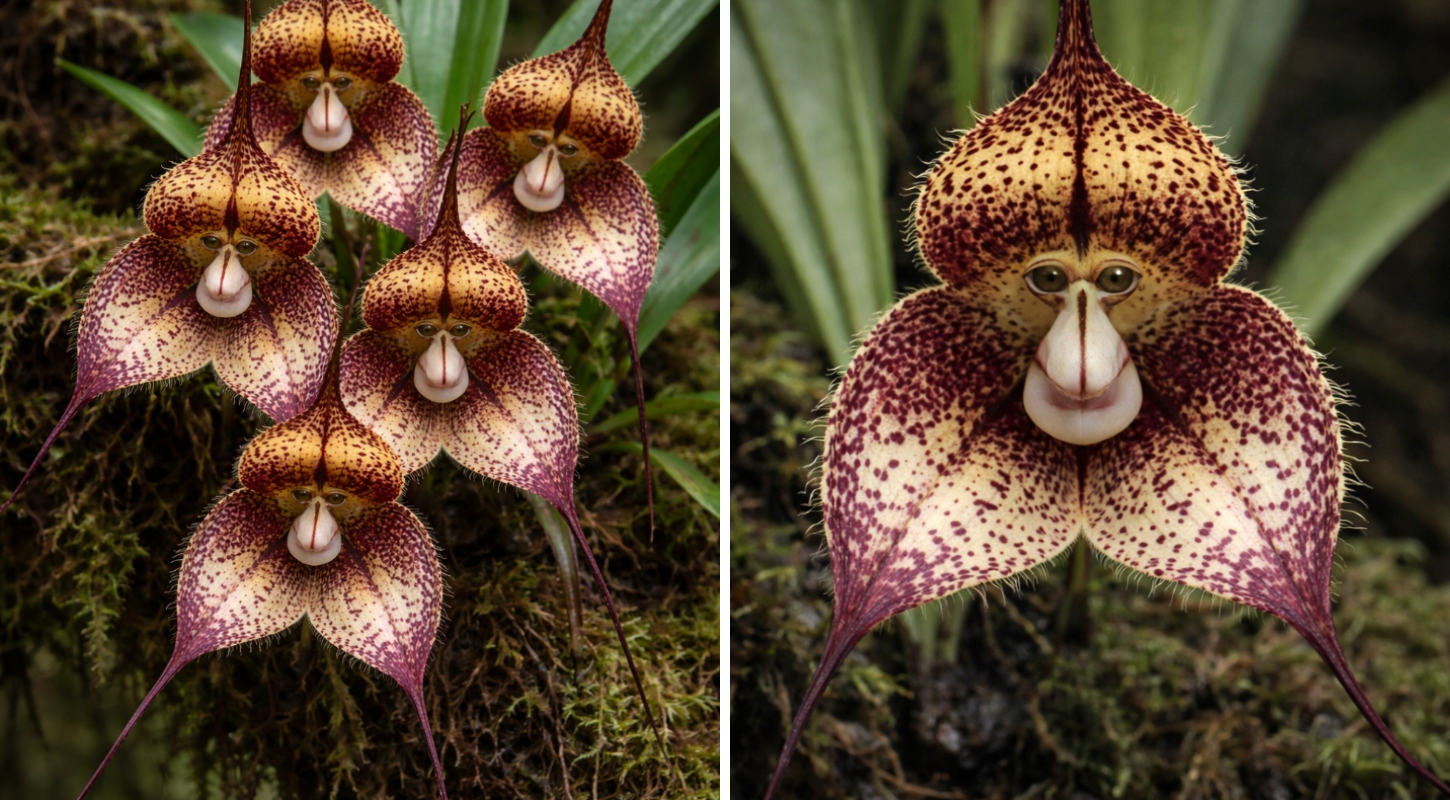
Nature has a habit of producing the kind of wonders that seem almost too strange to be real.
Thank you for reading this post, don't forget to subscribe!Every so often, the natural world unveils something so unusual that it feels like it belongs in a fantasy film rather than a rainforest. And among the countless plant species scattered across the planet, few are quite as charmingly bizarre as the Monkey Orchid.
For many people, gardening starts out as a casual interest before slowly turning into a full-blown obsession. A small patch of greenery becomes a personal sanctuary — a place where time, patience, and care transform ordinary soil into something beautiful. Even those who wouldn’t describe themselves as having “green fingers” can appreciate the appeal of cultivating plants and watching them thrive.
And then there are plants like this.
At first glance, the Monkey Orchid almost looks like a clever digital edit. The flower appears to have a tiny primate face nestled right in its centre — complete with what look like eyes, a nose, and even a fuzzy little muzzle. But this remarkable resemblance isn’t an illusion. It’s entirely real.
The plant’s official scientific name is Dracula simia, which translates to “little dragon monkey.” The unusual name reflects both the orchid’s distinctive shape and the slightly dramatic flair botanists sometimes bring to naming new species.
The Monkey Orchid is native to the southeastern forests of Ecuador and Peru, where it grows high in mountainous cloud forests. These misty environments sit between 1,000 and 2,000 meters above sea level and provide exactly the kind of conditions the plant needs to survive.
Cloud forests are known for their constant moisture, filtered sunlight, and cool temperatures — a combination that allows delicate plants like orchids to flourish. In these damp, shaded ecosystems, Monkey Orchids grow among moss-covered branches and dense foliage, blending into their surroundings despite their remarkable appearance.
The monkey-like face that gives the plant its name is created by the structure of the flower itself. The petals and stamens form a shape that strikingly resembles a tiny primate staring back at the observer. Each bloom looks almost identical to the next, as if nature decided to stamp a miniature animal face into every flower.
Despite the uncanny visual resemblance to a monkey, the plant doesn’t share any other traits with its animal counterpart — especially when it comes to scent.
Instead of anything wild or musky, Monkey Orchids produce a surprisingly pleasant fragrance. When the flowers bloom, they release a smell reminiscent of ripe oranges, adding another unexpected twist to an already unusual plant.
The species was formally named by botanist Carlyle A. Lueren in 1978, bringing global attention to one of the rainforest’s more whimsical creations. Since then, it has fascinated plant enthusiasts, gardeners, and nature lovers alike.
Orchids as a whole are already an incredibly diverse group. In fact, they form one of the largest plant families on Earth, with roughly 30,000 known species. With such an enormous variety, it’s perhaps inevitable that some members of the family end up looking a little unconventional.
The Monkey Orchid, however, sits comfortably near the top of the list when it comes to sheer novelty.
In its natural habitat, this orchid has the ability to bloom at almost any time of year. The steady humidity and cool climate of the cloud forest create an environment where the plant can continuously thrive without the strict seasonal cycles seen elsewhere.
Replicating those conditions at home, however, is far from easy.
Monkey Orchids require extremely high humidity levels — typically between 70% and 100% — along with cool temperatures and low light conditions. Those requirements make them a particularly tricky challenge even for experienced gardeners.
For anyone determined to try growing one, the plant is typically potted in sphagnum moss rather than traditional soil. This setup helps mimic the damp, airy conditions found in its natural environment.
When fully grown, a Monkey Orchid can reach heights of up to two feet, producing flowers that are both delicate and unmistakable. Placed in the right setting, they can easily become the most talked-about feature of any plant collection.
Interestingly, Dracula simia is just one member of a wider orchid genus known as Dracula. This group includes 118 different species, many of which are found across Ecuador, Peru, Mexico, Central America, and Colombia.
While not all of them resemble animals quite as convincingly as the Monkey Orchid, the genus is known for producing some of the most visually unusual flowers in the plant world.
For gardeners and plant lovers looking to add something truly unique to their collection, it’s difficult to imagine a more memorable option.
Because sometimes, the most fascinating discoveries aren’t found in science fiction — they’re quietly blooming deep within the forests of our own planet.
Featured image credit: World Manual (Created with AI to help illustrate this story)
