

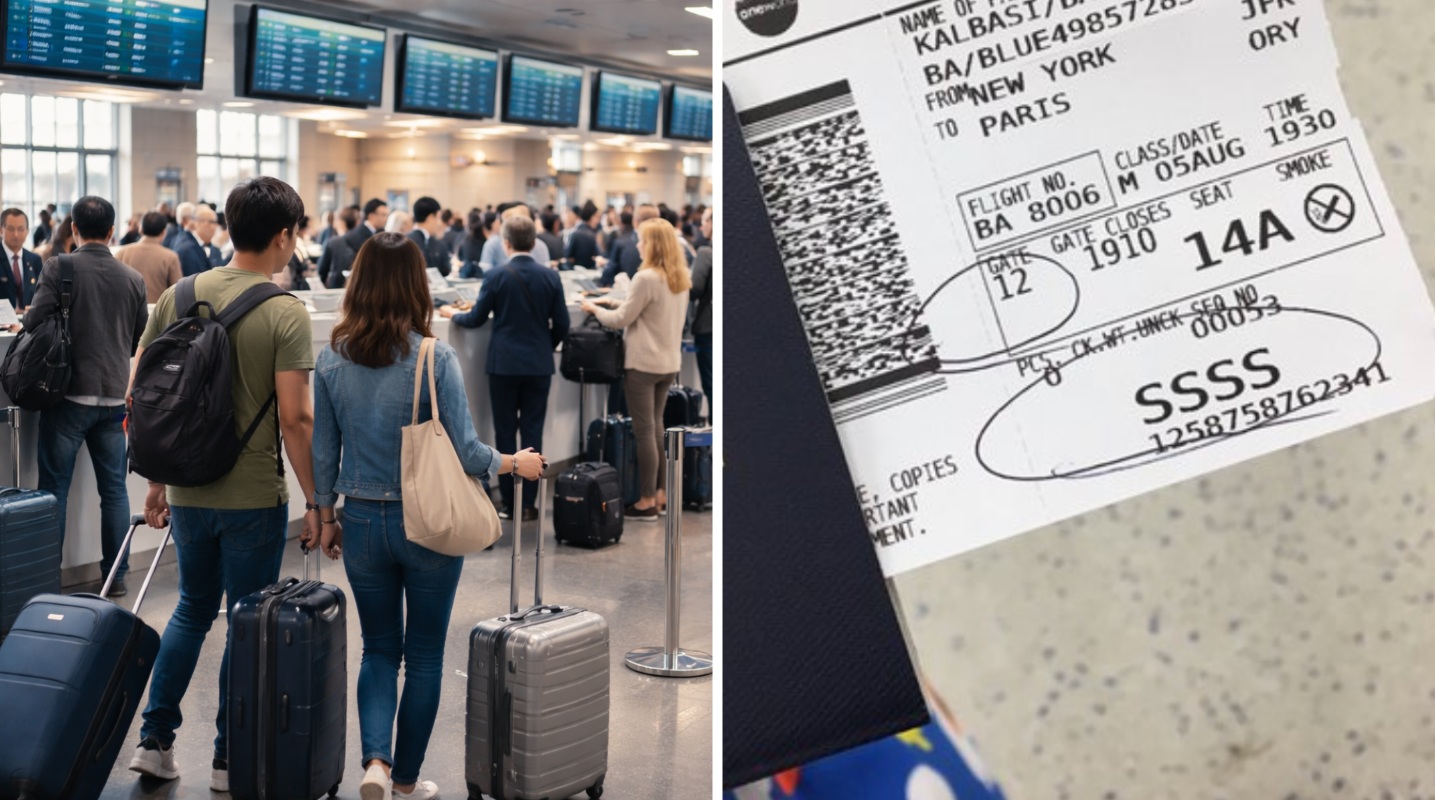
Airport security is stressful enough.
Thank you for reading this post, don't forget to subscribe!The queues. The body scanners. The frantic repacking of laptops and liquids. The overpriced sandwich you panic-buy because boarding has already started.
But for some passengers, there’s one detail that instantly turns mild airport anxiety into full-blown dread.
Four letters: SSSS.
If you’ve ever spotted it printed on your boarding pass, you’ll know exactly why travellers have dubbed it the “kiss of death.”
So what does it actually mean? Well, according to senior aviation writer for The Points Guy, Zach Griff, the code is “a measure implemented by security authorities in the US to screen certain passengers with additional checks.”
SSSS stands for “Secondary Security Screening Selection.” It’s a TSA protocol introduced after the 9/11 attacks, designed to trigger enhanced screening for certain passengers flying to, from, or within the United States, per the Metro.
In simple terms: You’ve been flagged.
Speaking to Fox News, Griff explained how the process works.
“Selectees for this enhanced security are chosen in the days leading up to a flight when airlines share the manifest with U.S. security authorities.
“SSSS can also be entirely random, and there’s no way to know when booking your flight whether you’ll be chosen as SSSS.”
That unpredictability is part of what makes the code so dreaded.
Once it appears on your boarding pass, your airport experience changes dramatically.
Passengers can be pulled aside for private pat-downs. Their bags may be opened and searched in detail. Electronics can be swabbed for explosive residue. Luggage and personal items are inspected more thoroughly than standard screening.
And it’s not optional.
The process can take anywhere from a few minutes to more than half an hour — sometimes long enough to cause missed flights.
One Reddit user shared their experience: “I’ve gotten SSSS several times flying back from Europe.
“Once, the extra security screening (done before getting to the boarding gate in my case) was so slow that my flight left. United booked my partner and me on new flights for the next day and got us a hotel. We couldn’t get seats on the same flights, however, so she left earlier than me. Next day, we go back to the airport, I get my new boarding pass, and SSSS is on it again.”
Another traveller wrote: “22+ hours of travel ahead of me and I already know that SSSS designation is going to make this hell.”
So who gets selected?
The Transportation Security Administration says many factors can be considered — but they don’t disclose specifics, per Travel and Leisure.
The Department of Homeland Security states that “many factors are considered to determine whether to select someone for secondary screening, but for security reasons they cannot be disclosed.”
However, known triggers can include booking one-way or last-minute tickets, paying in cash, travelling frequently to or from countries deemed “high-risk,” being on a government watchlist, or simply being randomly selected.
A US Senate report from December 2023 found that while the SSSS designation can be linked to unusual travel patterns or watchlists, it is “most often random”.
That hasn’t stopped frustration from building online.
One X user vented: “I’m SSSS on EVERY flight. Special treatment includes @TSA feeling & squeezing you & every single item in the luggage.”
Another posted: “Why do you SSSS me every time I travel to the Mideast? Come on already, can’t Americans travel freely without harassment?”
Some travellers speculate their own travel history plays a role. One user commented: “A flight history that includes multiple trips to Iraq and Libya will do that, I guess.”
On TikTok, creator @themobilehomie documented the moment her boyfriend was selected for screening.
“When your boyfriend gets SSSS, so you are now a solo traveller,” she said, filming as he was escorted away for private screening while she scrambled to separate their belongings.
The experience has become meme-worthy in some corners of the internet. On Reddit, users have jokingly called it the “kiss of death,” while others quipped that it’s “time to drop your pants.”
But behind the humour, there are serious concerns.
Civil liberties groups have raised red flags about how the system operates.
The Council on American-Islamic Relations (CAIR) filed a lawsuit in 2023 on behalf of a dozen plaintiffs, arguing that the SSSS designation and related government watchlist programs disproportionately target Muslim travellers.
In a statement, CAIR said: “The watchlist is Islamophobic. An expert statistical analysis of leaked portions of the 2019 watchlist estimates that at least 98.3% of the names on the watchlist are identifiably Muslim. That doesn’t happen by accident.”
The American Civil Liberties Union (ACLU) has also voiced concerns about transparency and potential racial profiling, arguing that unclear guidelines could open the door to discrimination.
So can you avoid it?
You can’t opt out entirely, but there is a potential workaround for frequent selectees.
The Department of Homeland Security offers the Traveler Redress Inquiry Program, known as DHS TRIP. Passengers who repeatedly receive the SSSS code can apply for a redress number, which — if approved — can be added to future bookings.
Travel expert Michelle, known online as @laxtoluxury, explained: “You can apply for a redress number, which prompts the DHS to review your record and clear up any erroneous or weird info that could be triggering the additional security measures.”
Even then, it’s not a guarantee you won’t be selected again.
In response to ongoing questions, a TSA spokesperson told Metro that the designation “pertains to TSA’s unpredictable security measures, both seen and unseen, to accomplish our transportation security mission.”
They added: “Security measures begin long before passengers arrive at the airport. TSA works closely with the intelligence and law enforcement communities to share information. Additional security measures are in place from the time passengers get to the airport until they arrive at their destination.”
There are also strict rules for airline crew. “KCM participants with a boarding pass showing SSSS are not permitted to use KCM access points,” the TSA website states, referring to the Known Crewmember programme that typically allows crew members to bypass standard screening.
With more than 904 million passengers screened in 2024 alone, the system is vast — and largely opaque.
Whether it’s random selection or something more complex, one thing is clear: those four letters can turn an already stressful airport experience into something far more intense.
So next time you check in and your boarding pass prints out, take a quick glance.
If you see SSSS staring back at you, you might want to skip the coffee queue.
You’re about to spend some quality time with airport security.
Featured image credit: WorldManual/X/@BahmanKalbasi (screenshot)
